Bulkhead Light Types: 9 Must Know Options for Ships & Offshore
Bulkhead lights are rugged wall- or ceiling-mounted luminaires built for shipboard and coastal environments where vibration, corrosion, spray, and tight spaces are normal. In marine salvage and refit work, the “right” bulkhead light type is less about looks and more about sealing, materials, beam control, and compliance needs—then aesthetics comes last.
What is a bulkhead light in marine terms?
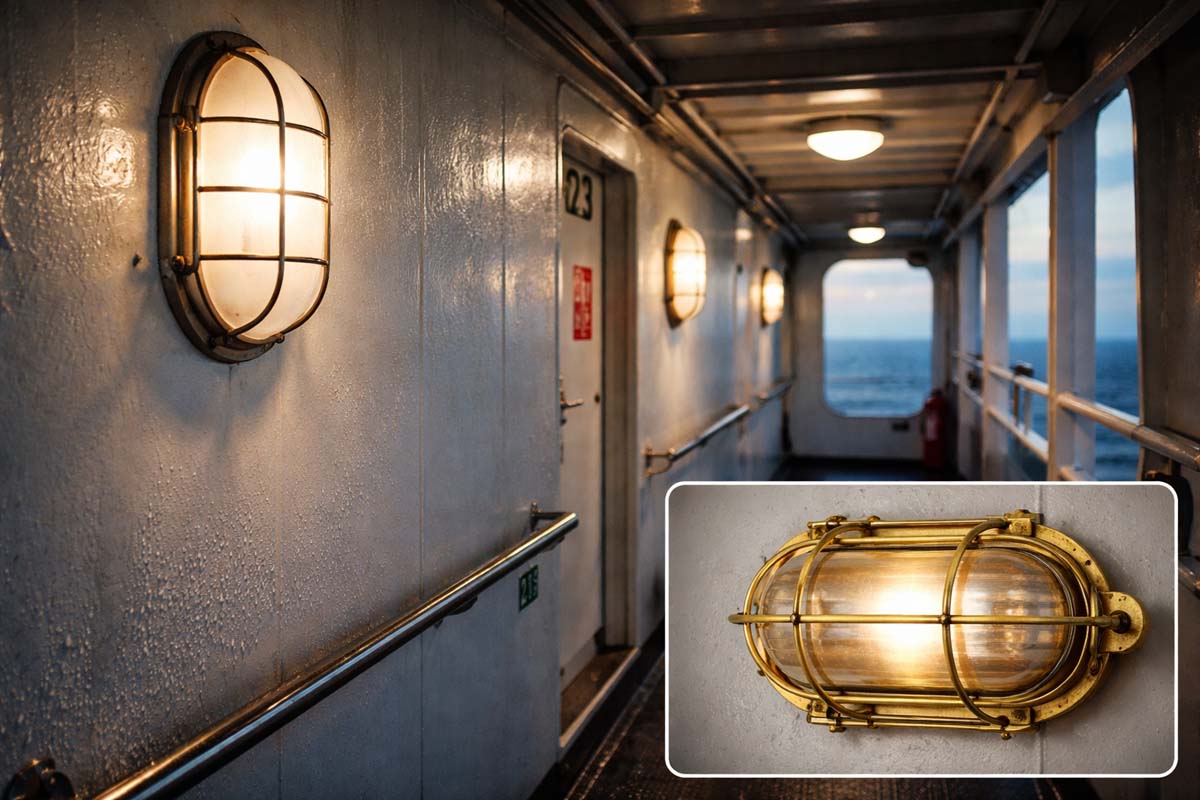
A bulkhead light is a compact, impact-resistant fixture designed to mount on a bulkhead (wall) or sometimes a low-profile surface on ceilings and deckheads. Marine versions are typically sealed against moisture and salt air, and built to survive vibration and handling—making them common across passageways, accommodation areas, engine-room boundaries, and exterior walkways.
For a broader view of what’s available right now, browse our marine ship lights collection and see which designs fit your space best.
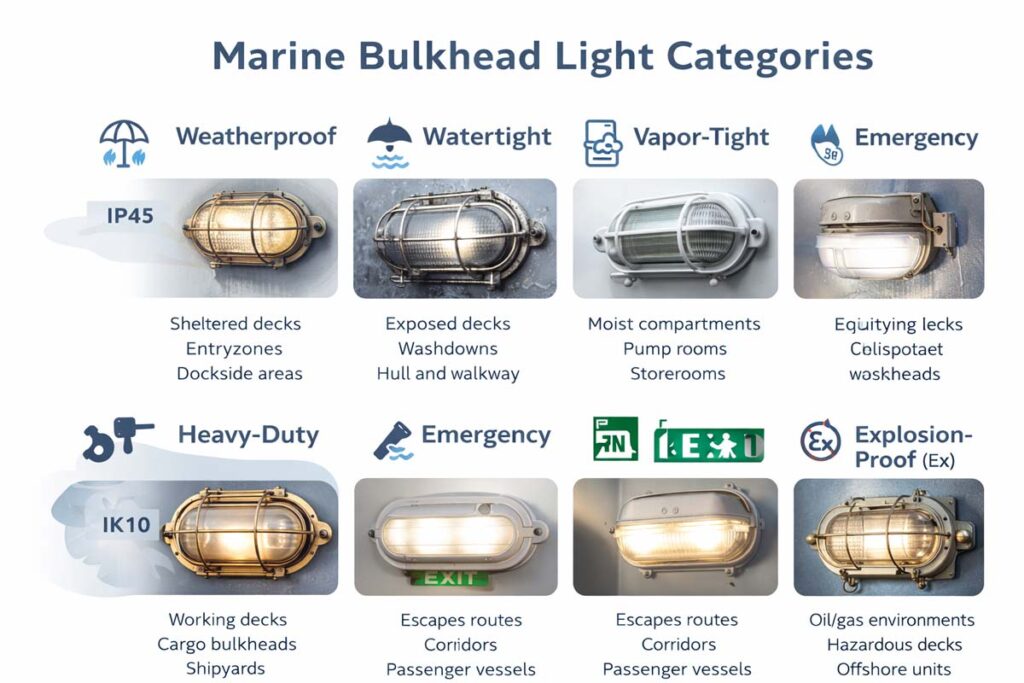
Bulkhead light types by sealing and protection
1) Weatherproof bulkhead lights
Best for: semi-exposed areas—covered walkways, exterior doors, sheltered deck zones, dockside buildings.
Typical features: gasketed lens, corrosion-resistant housing, basic drainage channels, stainless fasteners.
Selection tip: choose a meaningful IP rating (not just “waterproof”). The IP system is defined under IEC 60529.
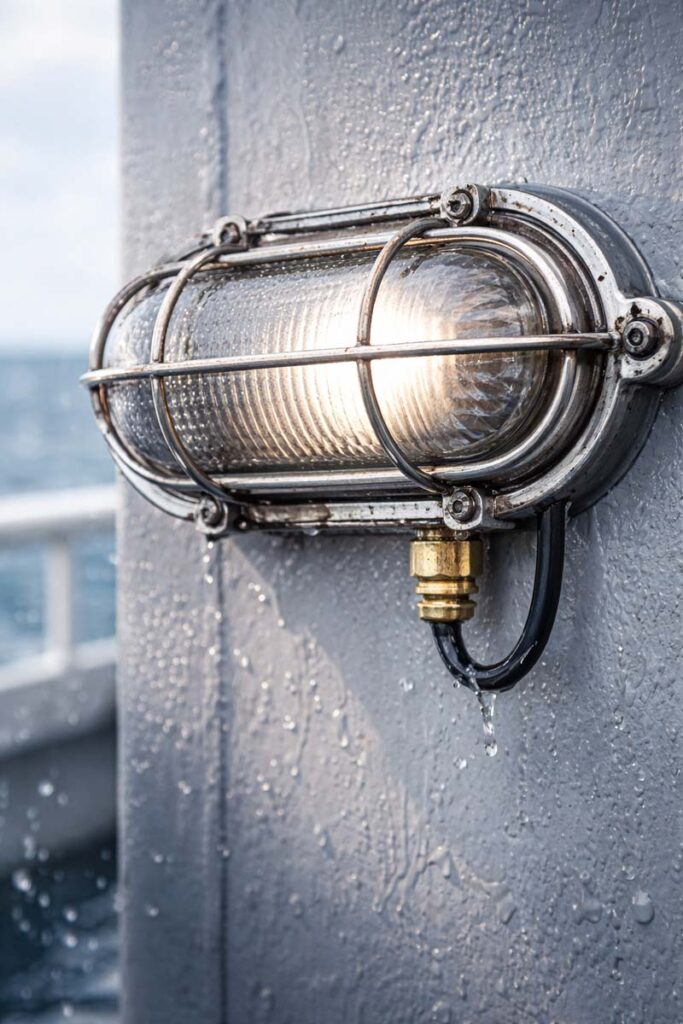
2) Watertight bulkhead lights (marine-grade)
Best for: fully exposed deck areas, washdown zones, bow/stern walkways, splash-prone bulkheads.
Typical features: stronger compression gaskets, tighter lens clamping, cable glands, thicker glass lens.
Common buyer concern: maintenance access—watertight fixtures often use multiple screws/clamps, so ensure crews can service them.
3) Vapor-tight / sealed bulkhead lights (interiors with moisture)
Best for: pump rooms (non-hazardous), stores, stair towers, utility corridors, damp compartments.
Typical features: sealed lens and housing, better dust resistance, stable performance in humid spaces.
Why it matters: dust + moisture inside a fixture accelerates corrosion and causes premature failures.
4) Heavy-duty impact-resistant bulkheads (industrial marine)
Best for: working decks, workshop bulkheads, cargo-related spaces, shipyard installations.
Typical features: guard cages, thick prismatic glass, reinforced housings, higher IK impact ratings (often specified on modern fixtures).
Bulkhead light types by application area on a vessel
1) Passageway / accommodation bulkhead lights
Goal: glare control and safe walking visibility.
Common forms: “oval” or “turtle” style with frosted/prismatic glass; often surface-mounted.
2) Engine-room boundary / machinery-space bulkhead lights (non-Ex)
Goal: high output, heat tolerance, resistance to vibration.
Common forms: compact but robust housings, metal guards, higher wattage (or higher-lumen LED retrofits).
3) Exterior deck bulkhead lights
Goal: survive salt spray, UV, washdowns, and knocks.
Common forms: heavy cast housings (aluminum/brass), glass lenses, stainless hardware, strong cable glands.
4) Service-area bulkheads (workshops, lockers, stores)
Goal: simple, reliable illumination with quick maintenance access.
Common forms: wire-guard bulkheads, simple prismatic lenses, standardized mounting footprints.
Bulkhead light types by construction and materials
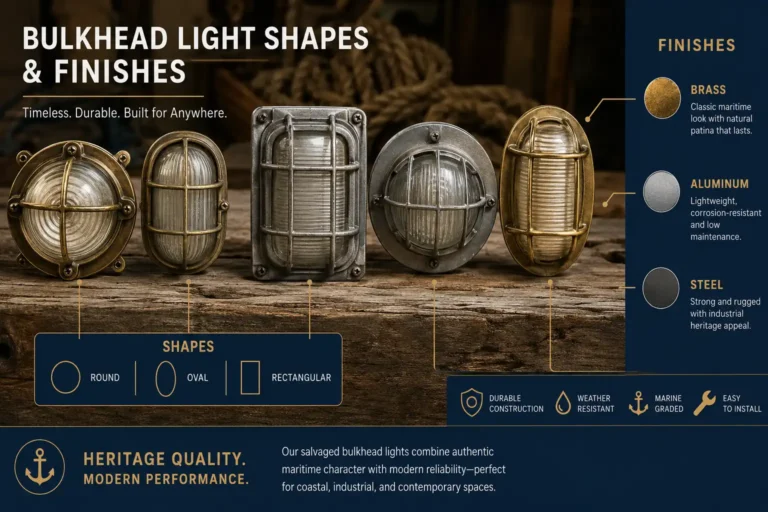
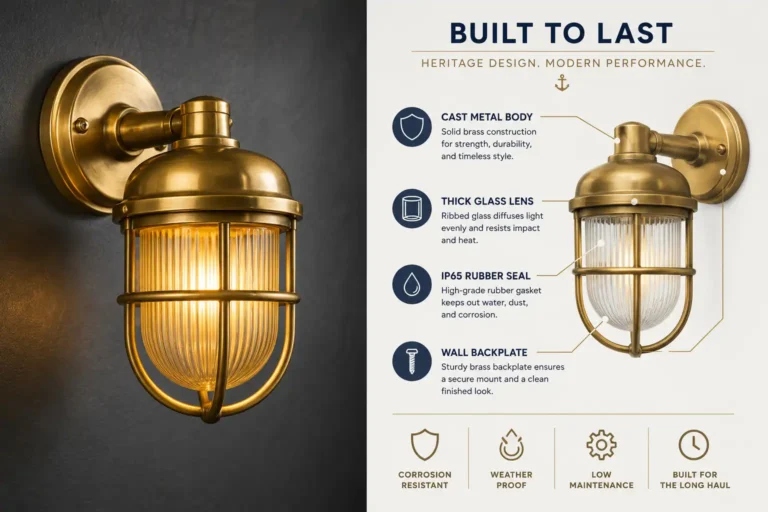
Cast brass bulkhead lights (classic marine + premium corrosion resistance)
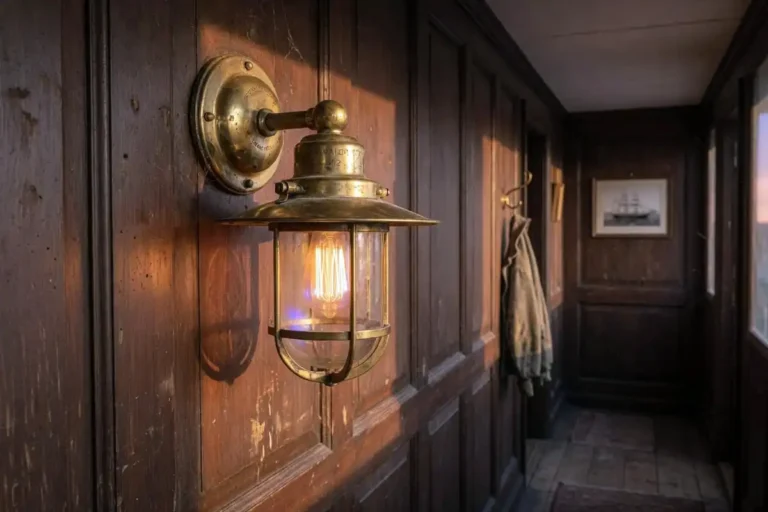
Why buyers love them: strong corrosion performance, authentic nautical look, excellent for heritage restorations and hospitality interiors.
Where they shine: superyacht refits, classic vessels, marine-themed properties, upscale décor.
Aluminum alloy bulkhead lights (lightweight + common on modern vessels)
Pros: lighter than brass, widely available, good thermal performance for LEDs.
Watch-outs: confirm coating condition; pitting can occur if neglected in harsh salt zones.
Stainless steel bulkhead lights (modern aesthetic + durability)
Pros: clean look, durable hardware, good exterior performance.
Watch-outs: grade matters (316 preferred near salt spray); surface tea-staining can still happen.
Cast iron / heavy industrial bulkheads (older shipyard style)
Pros: extremely tough, authentic “working vessel” look.
Watch-outs: rust management is essential—good candidates for blasting + marine coating systems.
Bulkhead light types by lamp technology (incandescent → LED)
1) Incandescent bulkheads (legacy)
Pros: warm light, simple wiring, period-correct for restorations.
Cons: heat, higher power draw, frequent bulb changes.
2) Fluorescent bulkheads (common in late-20th-century installs)
Pros: efficient for their time, diffuse light.
Cons: ballast failures, tube availability variability, vibration sensitivity.
3) LED bulkheads (modern standard)
Pros: low power draw, long service life, better vibration performance, easier emergency backup integration.
Key decision points: voltage (12/24V DC vs 110/220V AC), driver quality, color temperature, optics (diffused vs directional).
4) LED-retrofit bulkheads (ideal for salvage + refit)
For authentic housings from shipbreaking yards, the best of both worlds is often: restore the original body + upgrade the internals (LED board/driver, new gasket, new gland, rewired terminals). This keeps the “real ship” provenance while improving reliability.
Explosion-proof (Ex) bulkhead lights for hazardous areas
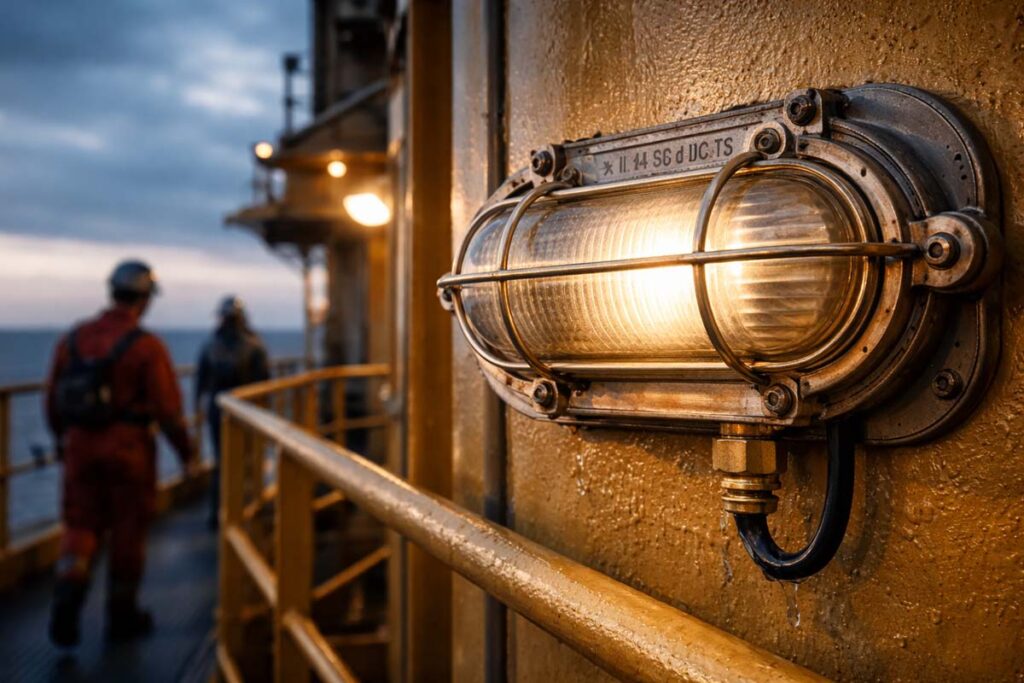
Explosion-proof / Ex bulkhead lights are built for locations where flammable gases/vapors or combustible dust may be present (common in parts of oil/gas marine operations and offshore). Certification and suitability are tied to standards and area classification systems (e.g., IECEx/ATEX frameworks using IEC 60079 series concepts).
Typical visual cues:
- heavier bodies and thicker lens retainers
- flamepath joints and certified cable entries
- marked ratings (zone/class/division, gas group, temperature class)
Buyer note: never “assume” an old fixture is Ex-safe because it looks heavy. Ex compliance depends on markings, documentation, and condition.
Emergency and escape-route lighting considerations
On passenger vessels and regulated installations, emergency guidance and lighting can fall under SOLAS/IMO safety expectations and associated guidelines (including documented inspection/testing regimes for escape-route systems).
Where bulkheads show up in emergency planning:
- stairways and passageway illumination
- low-level or guidance lighting integration (in some designs)
- power source changeover (transitional/emergency supply)
Practical takeaway: if a bulkhead light is intended for emergency use, confirm the requirement set (ship type, flag, class) and specify fixtures accordingly—don’t retrofit casually.
How to choose the right bulkhead light (buyer checklist)
Environment
- Interior dry / interior damp / exterior exposed / washdown zone
- Corrosion risk (salt spray proximity)
- Vibration and impact risk (working areas)
Protection level
- Select an appropriate IP rating per IEC guidance (avoid vague “waterproof”).
- Consider impact protection (guards, lens thickness, mounting strength)
Power & electrical
- Voltage: 12/24V DC or 110/220V AC
- Wiring entry: side, rear, or bottom; cable gland size
- Earthing/grounding method and terminal condition
Optics & comfort
- Frosted/prismatic glass for glare control in corridors
- Clear glass + directional optics where task lighting matters
- Color temperature: warm for hospitality/heritage, neutral/cool for work areas
Compliance fit
- Hazardous area? Require correctly certified Ex equipment.
- Emergency role? Align to vessel safety requirements and testing expectations.
Salvaged bulkhead lights: inspection, restoration, and retrofits (what “good” looks like)
For buyers sourcing from shipbreaking yards, the value is real: thick cast housings, proven marine designs, and authentic provenance. But every salvaged bulkhead should be treated as a project with a checklist:
Inspection essentials
- Housing cracks, thread damage, warping at gasket surfaces
- Corrosion pitting around lens seat and cable entry
- Lens condition (chips, star cracks), guard integrity
- Terminal block condition and insulation brittleness
Restoration options (typical scope)
- disassembly, media cleaning, corrosion treatment
- new marine-grade gaskets and stainless fasteners
- rewiring, new lampholder or LED conversion
- repaint/coating or polished brass finishing (as requested)
Buyer-ready outcomes
- “Heritage look, modern reliability” is usually achieved by keeping the original body and renewing the wear parts + electrics.
FAQs on Bulkhead Light Types
What’s the difference between weatherproof and watertight bulkhead lights?
“Weatherproof” usually suits sheltered or light-exposure areas, while “watertight” is intended for higher exposure and washdown. In both cases, rely on defined enclosure protection (IP system) rather than marketing labels.
Are brass bulkhead lights only decorative?
No. Brass is widely used for corrosion resistance and durability, so it can be functional in marine settings—while also being popular for nautical interior design.
Can I convert an old ship bulkhead light to LED?
Often yes—especially when the housing is structurally sound. The key is correct driver selection, heat management, gasket renewal, and safe wiring.
Do all engine-room bulkhead lights need to be explosion-proof?
Not automatically. Ex requirements depend on hazardous area classification and the presence of flammable atmospheres. If a space is classified hazardous, you must use correctly certified Ex equipment.
Closing: choosing the right bulkhead light type
Bulkhead lights look simple, but in marine reality they’re a reliability component—protecting people and operations in tight, wet, vibrating spaces. If you match the type (weatherproof, watertight, heavy-duty, Ex, emergency-capable) to the zone, then confirm IP protection, materials, voltage, and compliance needs, you’ll end up with a fixture that lasts—and still looks right.