What is a Marine Sextant and How Does It Work
Last spring, an old captain walked into our Chattogram yard holding a battered brass box. Inside sat a sextant his grandfather used on cargo runs to Singapore. He wanted to sell it. I held it up to the light and felt the same quiet respect I always feel for these instruments.
A sextant looks simple. It is anything but.
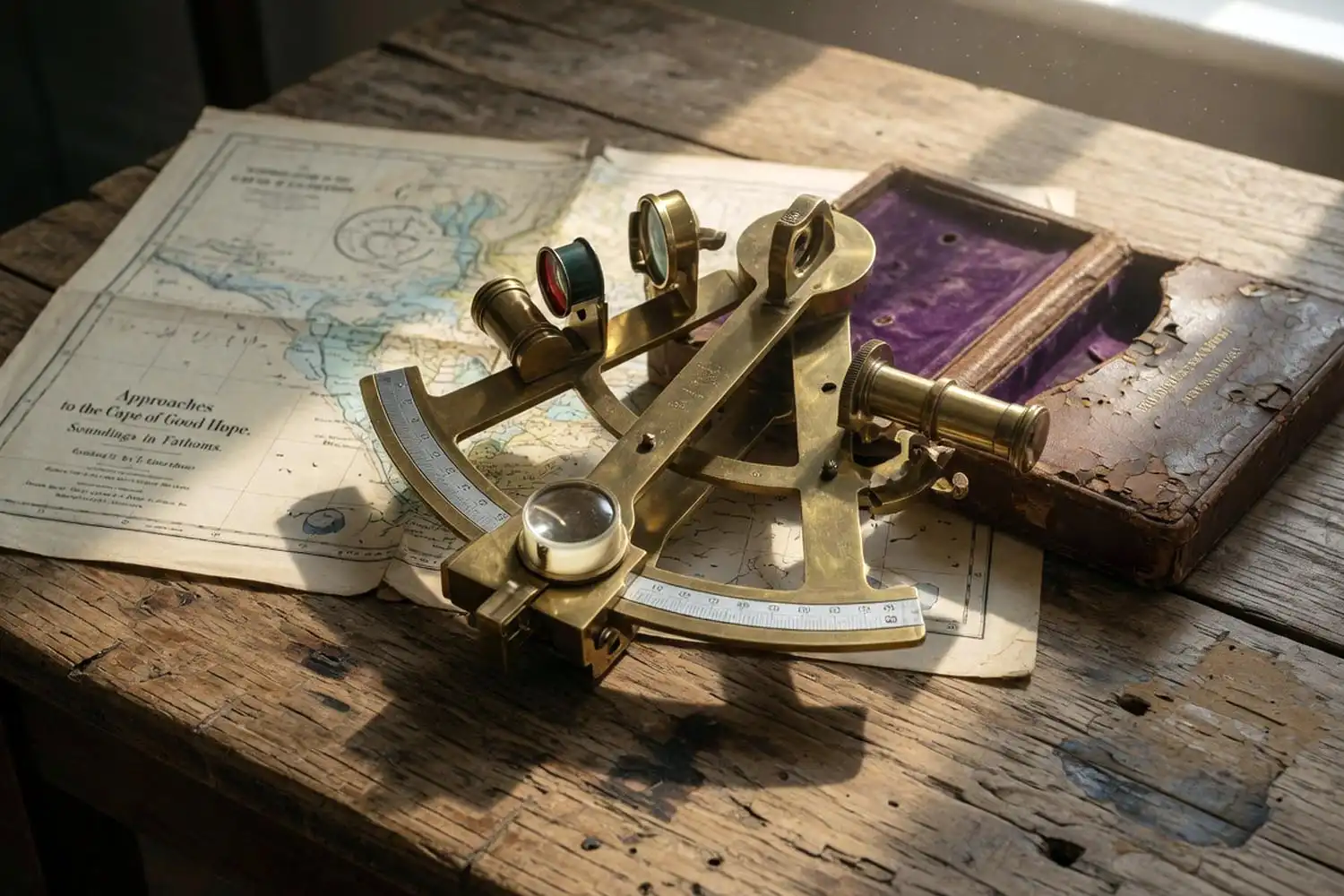
A marine sextant is a handheld optical instrument sailors use to measure the angle between a celestial body and the horizon. By reading that angle and the exact time, a sailor can calculate latitude and longitude at sea. It works through two mirrors that bring the sun or a star down to the horizon line.
How a Marine Sextant Works
The marine sextant works on a clever principle of reflection. One mirror sits fixed on the frame. The other moves along an arc marked in degrees.
When you point the instrument at the horizon, light bounces from the moving mirror to the fixed mirror, then into your eye. You swing the index arm until the sun appears to kiss the horizon line. The angle on the arc tells you the altitude.
The arc itself covers 60 degrees of curve. The name comes from the Latin word for “one sixth,” since 60 is one sixth of a full circle. Because of double reflection, that 60 degree arc actually measures 120 degrees of sky.
The Main Parts You Should Know
A proper sextant has six core parts. The frame holds everything together, usually cast in brass or bronze. The arc carries the degree markings. The index arm sweeps across the arc and holds the index mirror.
The horizon mirror sits near the telescope. Half of it is silvered, half is clear glass. Shade glasses flip in front of the mirrors to cut sun glare. A vernier scale or micrometer drum lets you read down to one minute of arc.
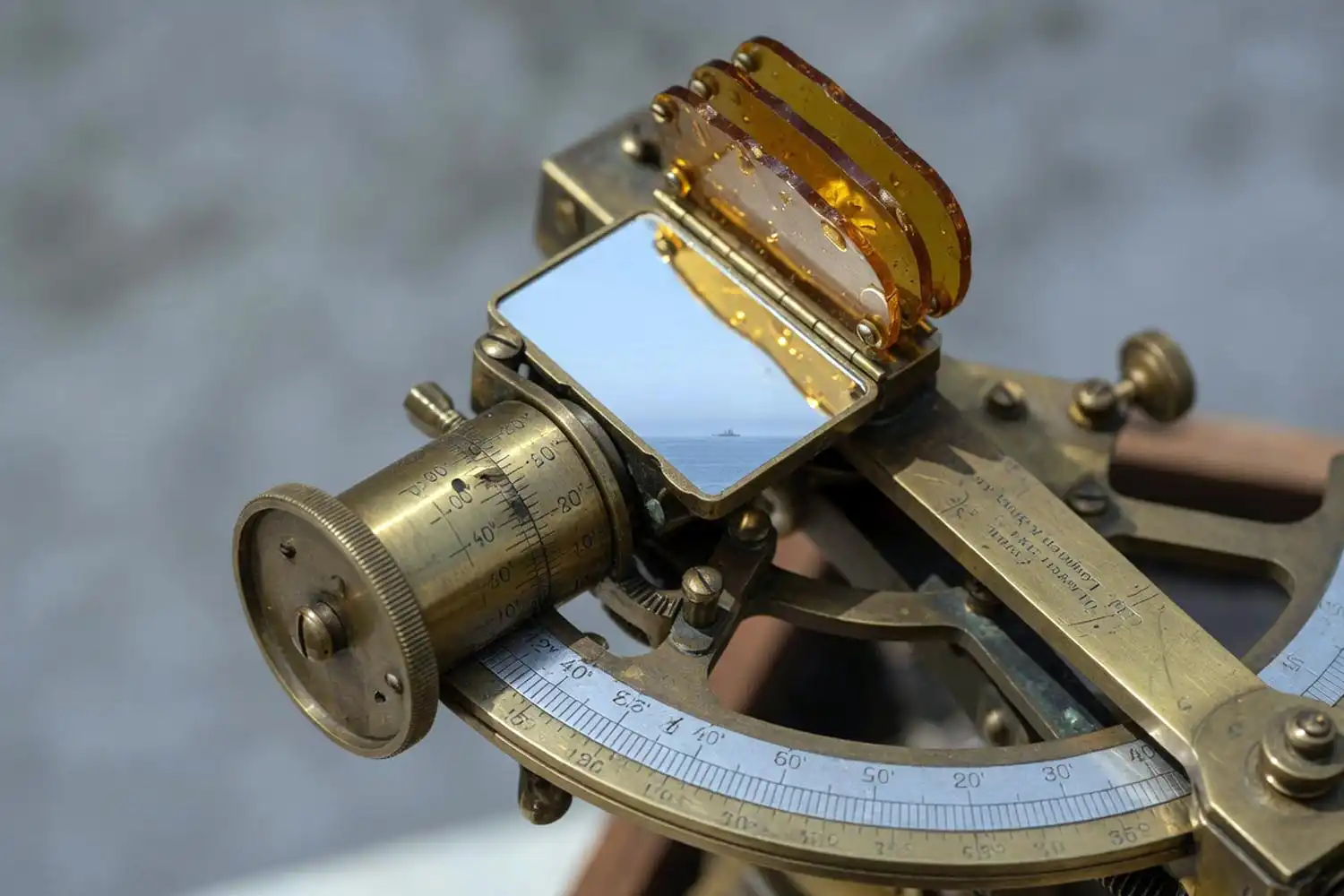
Some older models, like those built by Heath or Plath, use a tangent screw for fine adjustment. The telescope screws in and out depending on conditions. Every part matters. A bent index arm ruins every reading.
Taking a Sight Step by Step
Taking a sight feels harder than it looks. First, I set the shade glasses for the sun. Then I aim at the horizon with the index arm at zero.
I slowly swing the arm upward and rock the instrument side to side. The sun swings down in the mirror. When the lower edge touches the horizon, I freeze. I read the angle and check the time on the chronometer to the second.
Time matters here. One second off equals a quarter mile of error in your fix. Sailors call this “shooting the sun.” Most do it at noon for latitude, or use stars at dawn and dusk for a full position fix.
A Short History Worth Knowing
The marine sextant grew out of the octant, invented by John Hadley in 1731. Captain John Campbell extended the arc to 60 degrees in 1757. From then on, ships could measure lunar distances and calculate longitude at sea.
Before the sextant, sailors guessed their east-west position using dead reckoning. Many died because of it. The instrument changed open ocean travel forever. If you collect old ship gear, you can read more about the history of authentic maritime brass instruments and antiques on our catalog pages.
Why Sailors Still Carry One Today
Sailors still carry a sextant because GPS can fail. Satellites go dark. Batteries die. Solar flares scramble electronics. A good brass sextant needs no power and never crashes.
The US Naval Academy brought celestial navigation training back into its curriculum in 2015. Commercial captains stash one in the chart room as backup. Yacht owners on long passages keep one ready. The skill is quiet insurance.
Spotting an Authentic Vintage Sextant
Authentic vintage sextants carry maker’s marks on the frame. Look for names like Heath, Plath, Tamaya, Hughes, or Cassens & Plath. The serial number should match the certificate, if you are lucky enough to find one.
Real brass feels heavy in the hand. Reproductions feel light and tinny. Check the mirrors for silver flaking. Spin the tangent screw. It should turn smooth without grit. Many of the same authentication clues for identifying genuine old ship lanterns apply here too.
A few pieces in our photo gallery of restored ship items show what good condition looks like after careful cleaning.
Final Thought
A marine sextant carries the weight of three centuries of sea travel in one small brass frame. Hold one and you hold the same tool that crossed Cape Horn and the Pacific before engines existed.
If you are interested in buying maritime collectibles for use or display, take your time. Check the mirrors, the arc, and the maker. A good sextant outlasts its owner. Good luck with the hunt.