How Do Ship Deck Lights Work? A Salvage Dealer Explains
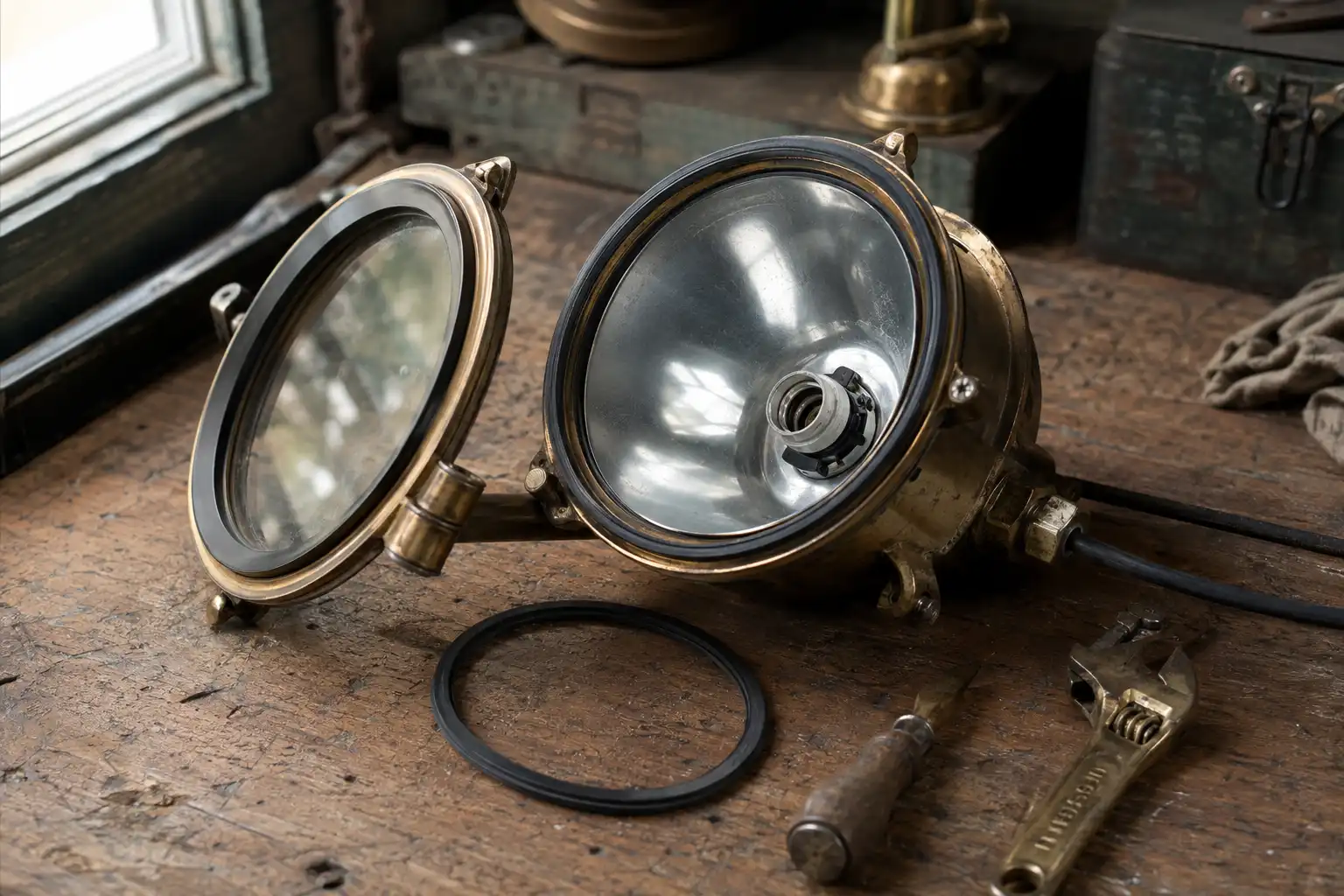
Last month I opened a 500 watt deck floodlight that came off a Panamax bulker. Twenty years at sea, then the breaking yards here in Chattogram. The glass was hazed white with salt. The polished reflector behind it still shone like a shaving mirror. When I pressed the gasket with my thumb, it was still soft. That one fixture explains the whole subject. Nothing inside a deck light is clever. Everything inside it is sealed.
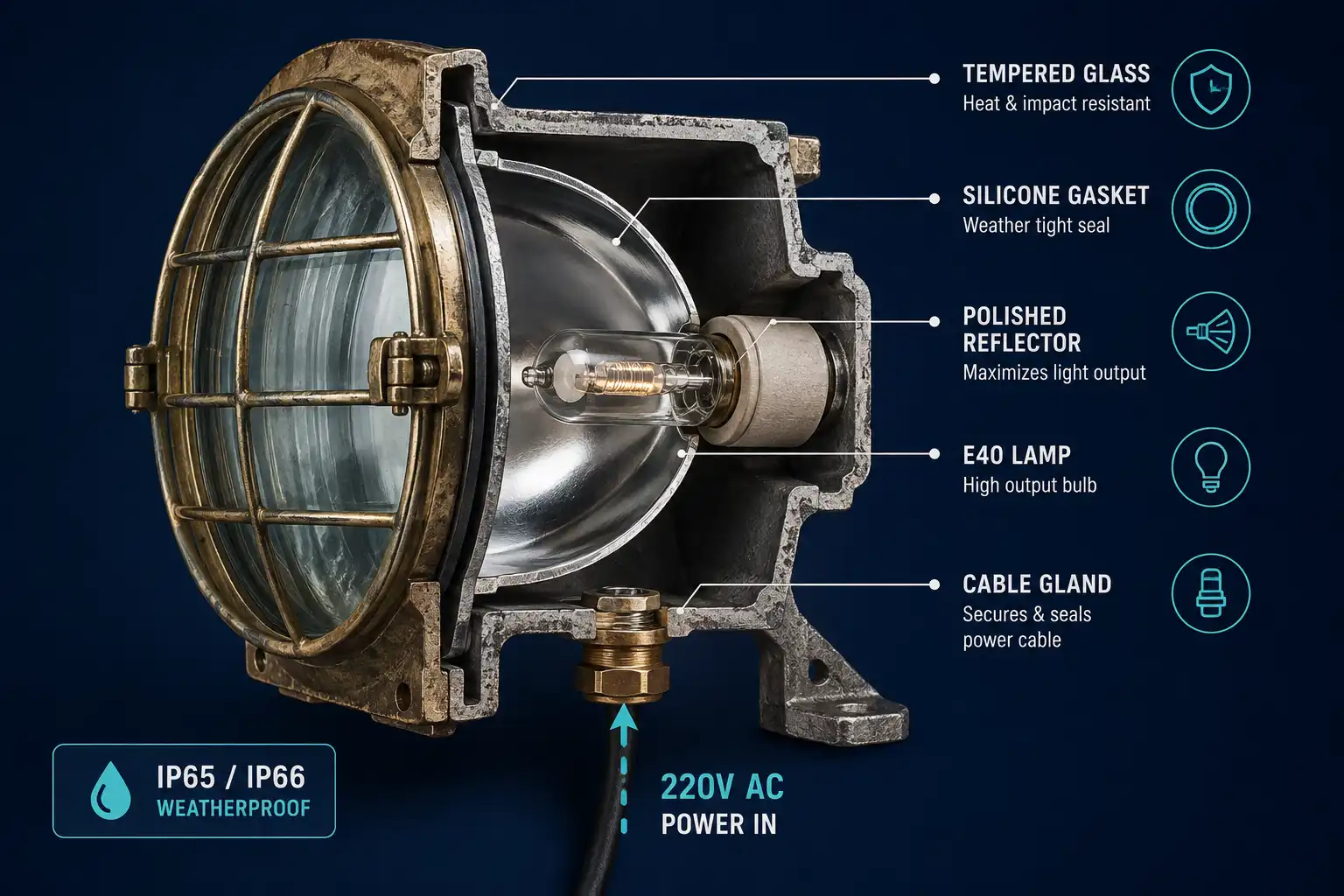
A ship deck light works by sealing a high output lamp inside a cast metal housing behind thick tempered glass. A polished reflector throws the light down and outward across the working deck. A compressed silicone gasket stops salt water at the glass line, and the ship’s power reaches the lamp through one watertight cable gland.
What a Deck Light Is Actually For
Deck lights are work lights. Crews use them to load cargo at two in the morning. They light the mooring station and the wet steel deck you cross in the dark. They were never built to be pretty. I go through which fixtures genuinely qualify as deck lights in a separate piece.
The design follows the abuse. Salt spray, green water over the bow, engine vibration, tropical sun, freezing spray in the North Atlantic. One fixture handles all of it for decades.
Know more: How to Install Deck Lights So They Stay Dry
How Do Ship Deck Lights Work, Part by Part
The housing
Most are cast from marine grade aluminum, copper free, then anodized and powder coated. Heavier ones use 316 stainless steel. The walls are thick for two reasons. They shrug off knocks from cargo gear, and they pull heat away from a lamp that can run at 1000 watts.
The glass and the reflector
The front pane is tempered safety glass, picked for thermal shock. A hot lens takes cold spray without cracking. Behind the lamp sits a polished anodized aluminum reflector, and that reflector decides the beam. Wide ones spread light across roughly 90 to 120 degrees for general deck work. Narrow ones tighten to 15 to 30 degrees when you need reach down a long cargo hold.
The gasket
This is the part doing the real work. A silicone gasket sits between the glass frame and the body. Stainless bolts squeeze it evenly the whole way around. Get that compression right and the fixture holds an IP66 rating for years. Leave one bolt slack and water finds the gap. Almost every failure I see traces back to that seal. I put together a guide to chasing down moisture inside an old deck lamp.
The cable gland
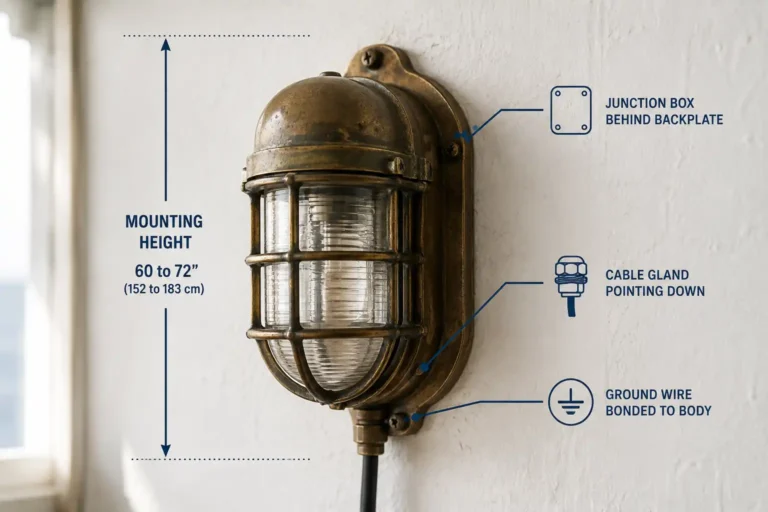
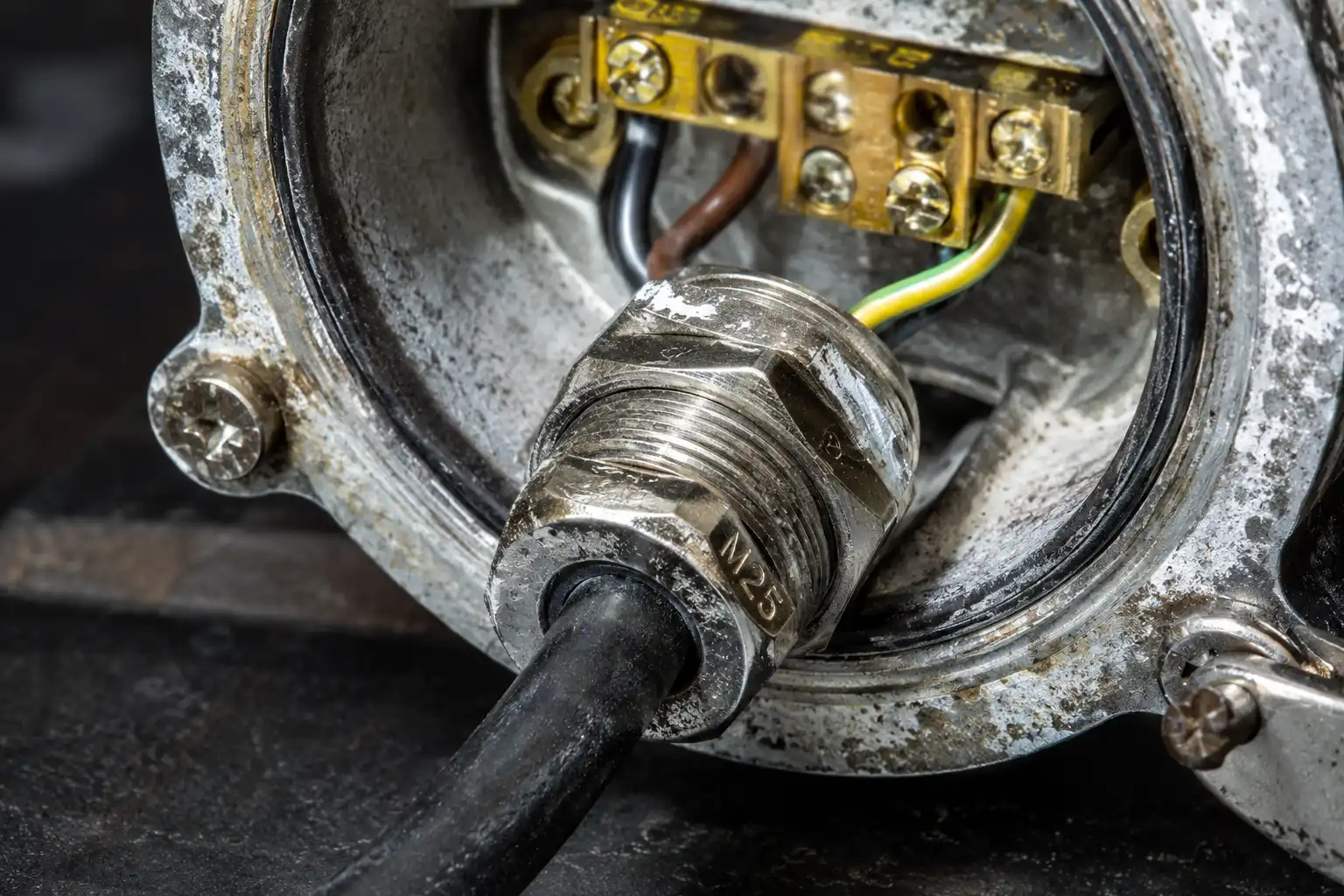
Power enters through a single gland, usually an M20 or M25 in nickel plated brass or 316 stainless. Inside it, a compression nut squeezes a rubber ring tight around the cable jacket. That gives you the second sealed opening, and a deck light only ever has two. For the short version of how watertight these fittings really are, I have covered that ground already.
The lamp
Here is where age shows. My oldest fixtures take a plain E40 incandescent bulb at 300 to 500 watts. Then came quartz halogen up to 1500 watts. Through the eighties and nineties, high pressure sodium and metal halide took over. Both need an external ballast mounted nearby. A 1000 watt metal halide in an E40 socket puts out around 120,000 lumens.
LED replaced all of it. Current drivers accept 100 to 277 volts AC and run past 50,000 hours with no ballast. Old halogen managed 2,000 to 4,000 hours.
Read next: How to String Deck Lights So They Last All Season
Where the Power Comes From
Main shipboard distribution is three phase, 440 volts, 60 hertz. Lighting circuits get stepped down to 110 or 220 volts AC. Smaller vessels run 12 or 24 volt DC instead. Marine fittings are built to the IEC 60092 series, part 306 covering luminaires. They carry class society approval from bodies like ABS, Bureau Veritas or CCS.
Why Aiming Matters More Than Wattage
A deck light aimed badly is worse than no deck light. COLREG Annex I states that sidelights must not sit so low that deck lights interfere with them, and Rule 20 backs that up. So deck floods tilt downward on adjustable stainless yoke brackets, often with a visor over the top. The beam lands on steel instead of blinding a passing vessel or the officer on watch. The red and green lights at sea run on entirely different rules, and I explain how those signals actually function elsewhere.

What Changes When One Comes Ashore
Mechanically, nothing. The gasket, gland and glass behave the same on a garden wall as they did on a forecastle. What changes is the lamp and the circuit. I fit an E27 adapter or a small LED module, run new cable through the original gland, and leave the seal untouched. Most of the reclaimed floodlights sitting on my shelves get that treatment before they ship. Putting one on a house circuit is work for a licensed electrician. I walk through the detail in my notes on running power to a salvaged nautical fitting.
Final Thoughts
Ship deck lights last because they were built simple on purpose. Two openings, one good gasket, thick metal, honest glass. That is the entire trick. It is why a fixture from 1978 still works when a modern garden light dies in three winters. Find one with soft silicone and a bright reflector and you have bought well. Good luck with yours.