What Bulb Goes in a Bulkhead Light: Socket, Watts, and Heat
Most bulkhead lights that come into my yard in Chattogram still have the old bulb inside. Usually a fat incandescent, blackened at the tip, sitting in a porcelain socket that smells faintly of scorched varnish. Buyers ask me what bulb goes in a bulkhead light once they get it home. The fixture rarely tells them. On plenty of these housings the wattage label corroded away decades ago, somewhere between the Persian Gulf and the beach here.
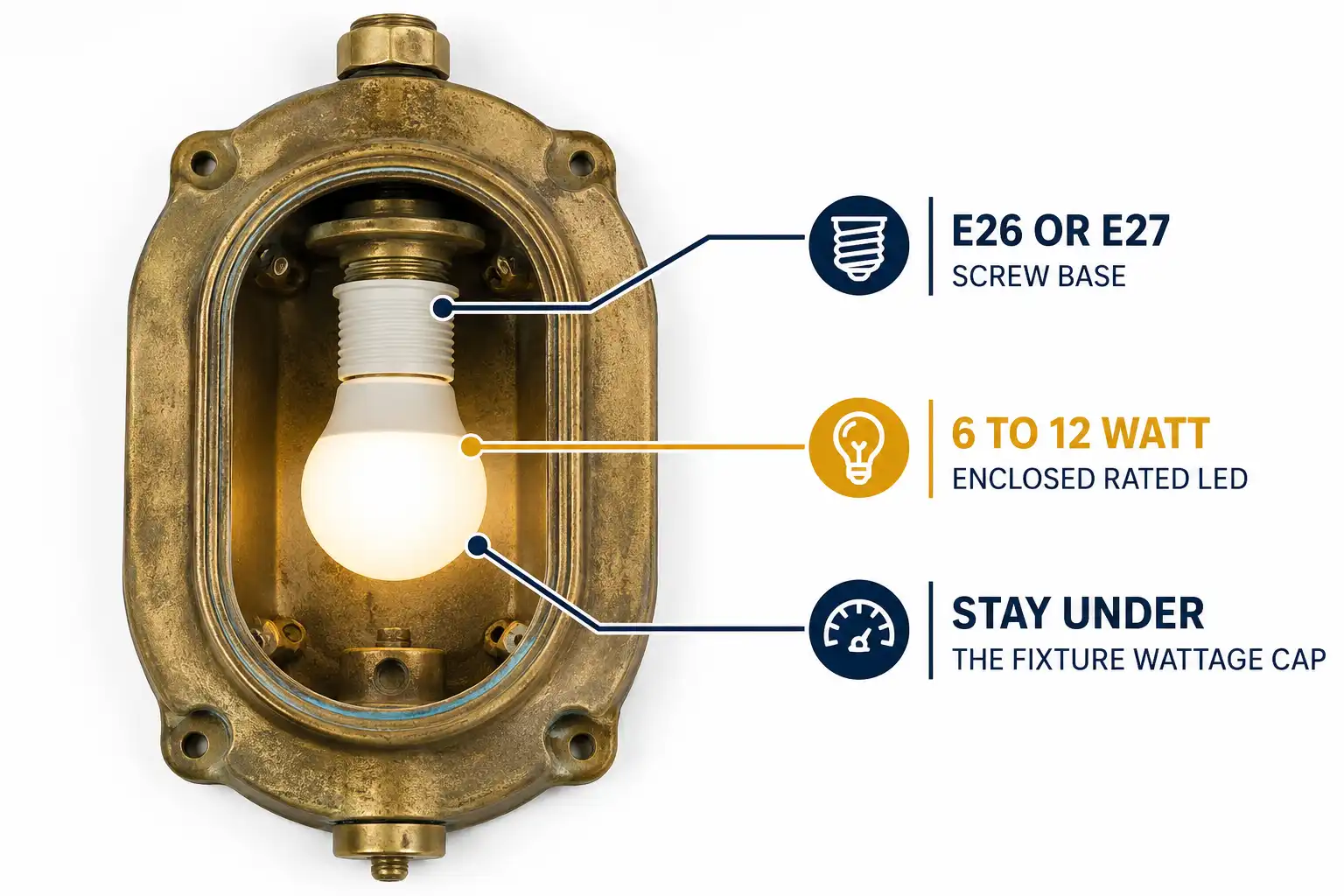
Most bulkhead lights take a standard screw-base bulb: E26 in North America, E27 in 220 volt countries, or a B22 bayonet on older British-built fixtures. An enclosed fixture rated LED between 6 and 12 watts suits nearly every one. Stay under the wattage printed on the housing and match the bulb to your supply voltage.
Start With the Socket, Not the Bulb
Open the fixture and look inside. The socket decides everything after it.
Medium Edison screw is the most common holder by far. That is E26 in the United States and E27 across Europe, Asia, and Australia. The two thread into each other easily, but they follow different electrical safety standards: E26 for 120 volt supply, E27 for 220 to 240 volts. Buy the version certified for your country’s current.
Ships built in Britain and India often carry B22 bayonet holders, the two-pin push and twist type. Small fixtures sometimes use E14 or E12. The various housing styles I pull off ships vary in socket size too, so measure rather than assume.
Watch the Wattage Cap on the Housing
The number cast or stamped on the fixture is a heat limit, not a brightness suggestion. Caps of 40, 60, and 75 watts are typical. That figure protects the socket, the internal wire insulation, and the rubber gasket behind the glass.
An incandescent bulb turns most of its energy into heat. Push 100 watts through a 60 watt housing and the insulation cooks, the paint blisters, and the socket contacts scorch.
LED changes the arithmetic. A bulb sold as a 100 watt equivalent draws roughly 14 actual watts. Actual draw is what counts against the cap, not the equivalence claim on the front of the box. Read the fine print. If you are still choosing a fixture diameter for the wall, check its wattage rating at the same time.
Why the Bulb Needs an Enclosed Fixture Rating
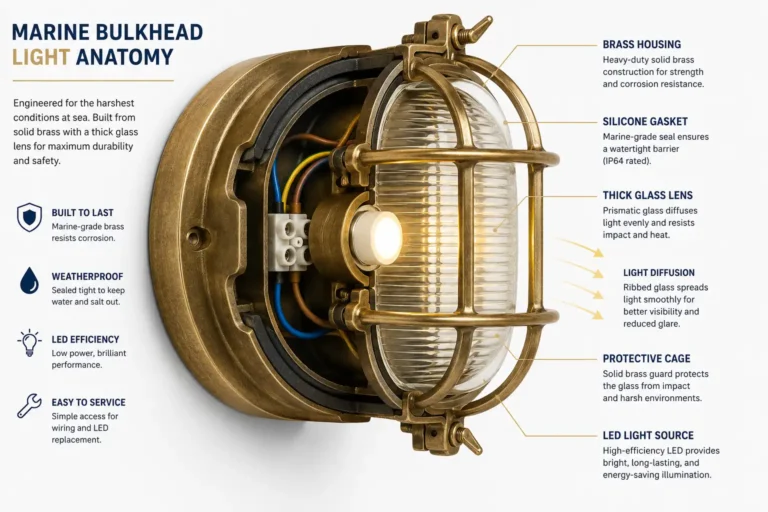
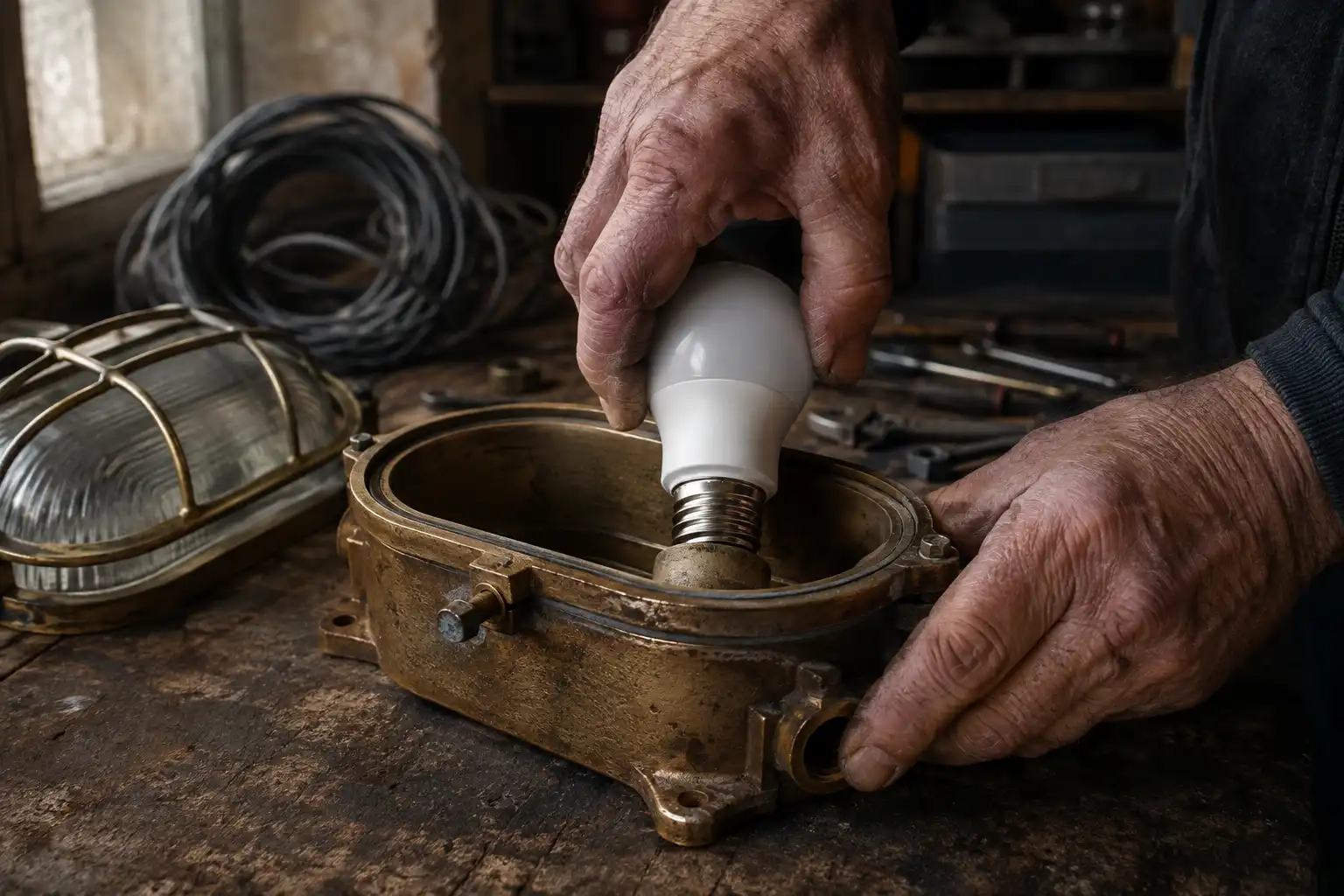
A bulkhead light is a sealed box. Thick glass, a cast housing, a compressed gasket, and often a protective cage. Air barely moves inside, which is exactly how the gasket and glass keep water out in the first place.
Trapped heat is hard on LEDs. The driver in the base holds heat-sensitive electronics. Overheat it and you get early failure, flicker, or a color shift as the phosphor degrades. Manufacturers test for this and print “suitable for enclosed fixtures” on qualifying packages. No such wording means treat the bulb as open-fixture only.
Wet location listing is a separate rating. Outdoors you want both on the same bulb.
What Bulb Goes in a Bulkhead Light Outdoors?
Outdoors I fit an enclosed fixture rated LED, wet or damp location listed, drawing 6 to 12 watts. That gives roughly 450 to 1,000 lumens. Plenty for a doorway, a porch, or a dock post, and the low heat protects old wiring.
Color temperature matters more than people expect. 2700K reads warm and flatters aged brass and bronze. 3000K stays warm but looks cleaner near steps and gates. I skip 5000K on salvaged fixtures. Blue-white light against old metal looks cheap. Think about where these fixtures sit best inside and out before settling on a color.
Bulb Shape and Clearance Behind the Glass
Measure the space before ordering. A standard A19 bulb (A60 in metric markets) fits most bulkhead housings. Shallow ship globes need a smaller G45 round bulb or a C35 candle shape.
Leave air between the bulb and the glass. Contact creates a hot spot and cracks the lens over time.
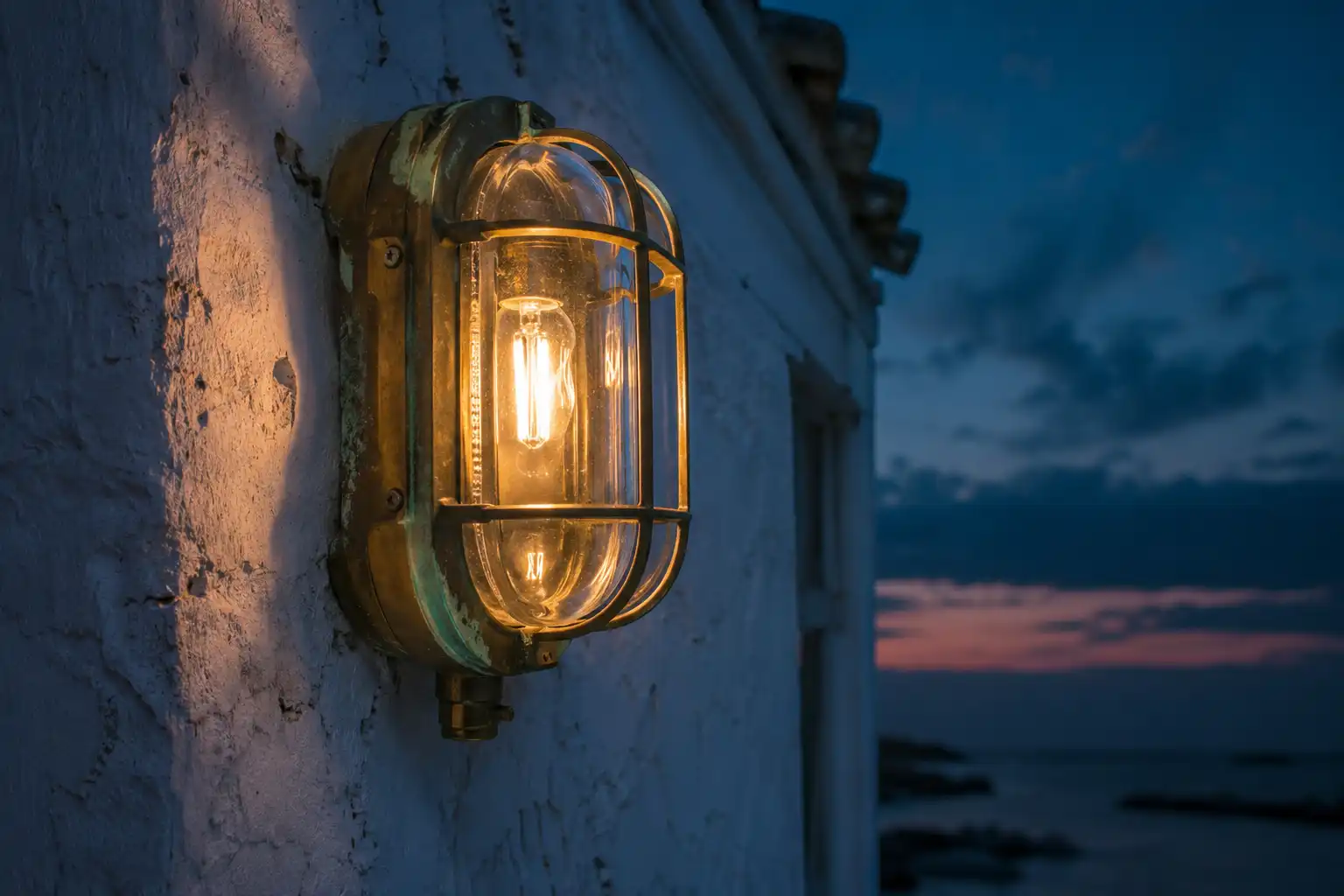
Frosted bulbs behind clear ship glass cut glare, which suits the way these fixtures spread light across a wall. Clear filament bulbs look better behind an open cage than behind flat prismatic glass.
Ship Voltage Versus House Voltage
Accommodation lighting on large ships runs at 110 or 220 volts AC, stepped down from the main switchboard. Small vessels and emergency circuits run 12 or 24 volts DC.
So the bulb still in a salvaged fixture reflects that ship, not your house. A 24 volt bulb on household mains dies instantly. Check the old bulb and the nameplate first, then handle the rewiring of an old salvage fixture before fitting anything new.
Bulbs I Skip
- Halogen: too much heat inside a sealed housing.
- CFL: slow to brighten, weak in cold air, poor life in enclosed spaces.
- Unlabeled bargain LEDs: no enclosed rating, no safety listing, short life.
- Non-dimmable LED on a dimmer circuit: flicker and buzz.
Final Thought
Get the socket right, respect the wattage cap, and buy an enclosed fixture rated LED. That combination keeps a fifty year old fixture safe and lit for years without cooking its own wiring.