What Are Ship Searchlights and What Do They Actually Do?
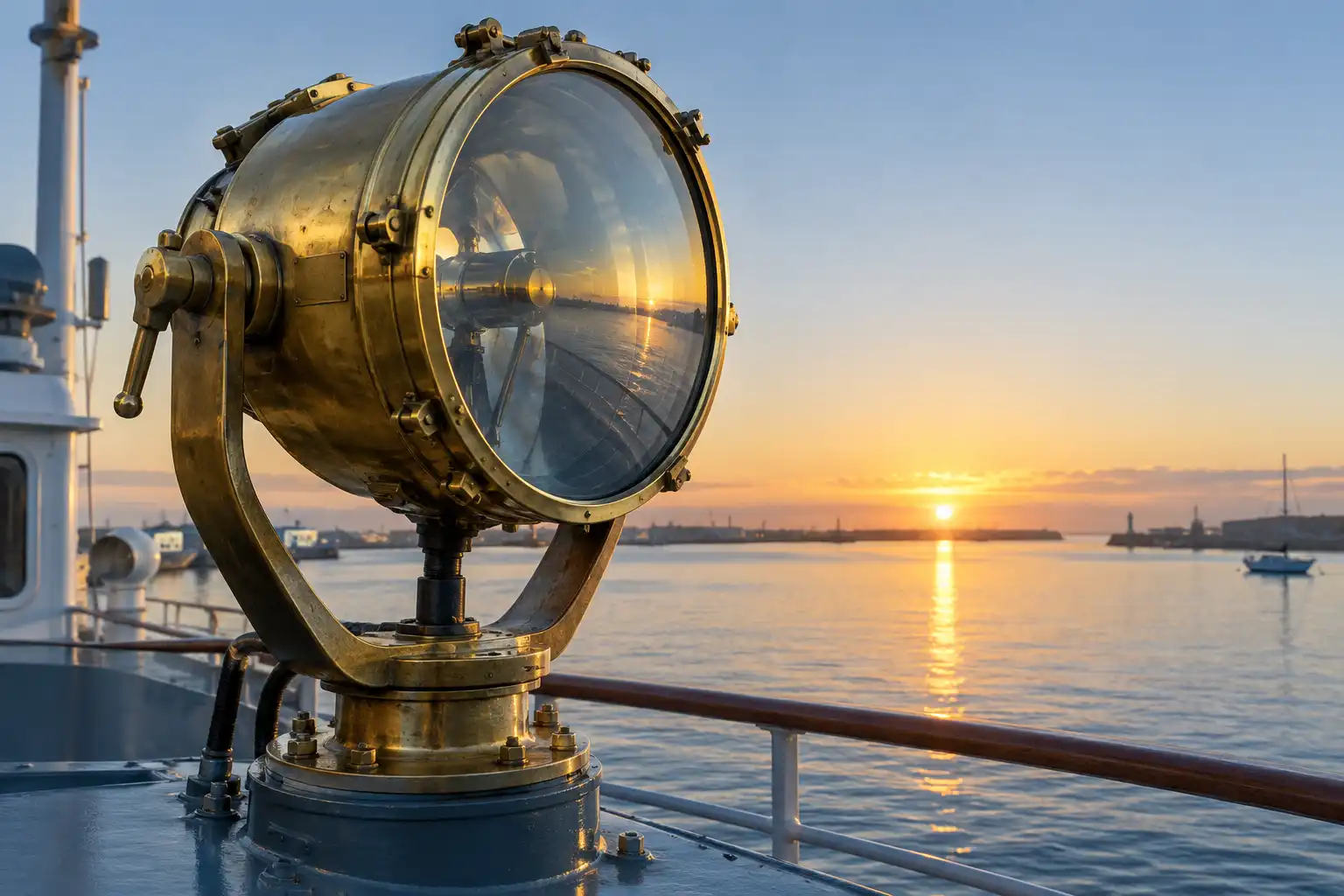
The first searchlight I pulled off a bulk carrier took three of us to get down the ladder. Twenty two kilos of brass, glass, and a reflector still bright enough to hurt your eyes. The drum swung free on its gimbal after thirty years at sea. Buyers see the round shape and call it a spotlight. It is not. A searchlight throws a beam over a mile, and every part in that drum serves that one job.
Ship searchlights are high intensity, aimable lamps that throw a narrow beam far ahead of a vessel. A parabolic reflector sits behind the bulb and pushes the light out as a tight column instead of a glow. Crews use them for pilot transfers, man overboard searches, canal transits, and mooring work after dark.
What Ship Searchlights Do on a Working Vessel
They find things in the dark that radar misses.
Pilot boarding is the most common use. The officer lights the ladder and the pilot boat alongside, so nobody steps into a gap.
In a man overboard case, the beam holds the person in the water while the rescue boat launches. Losing sight of a head in a swell usually ends badly.
Mooring crews read bollards, buoys, and line positions. River and canal pilots pick out bank edges. Ice, floating logs, and lost containers show in the beam before a lookout spots them by eye.
Some operators fit high output units as an anti piracy deterrent. A skiff crew loses their night vision the moment the beam lands on them.
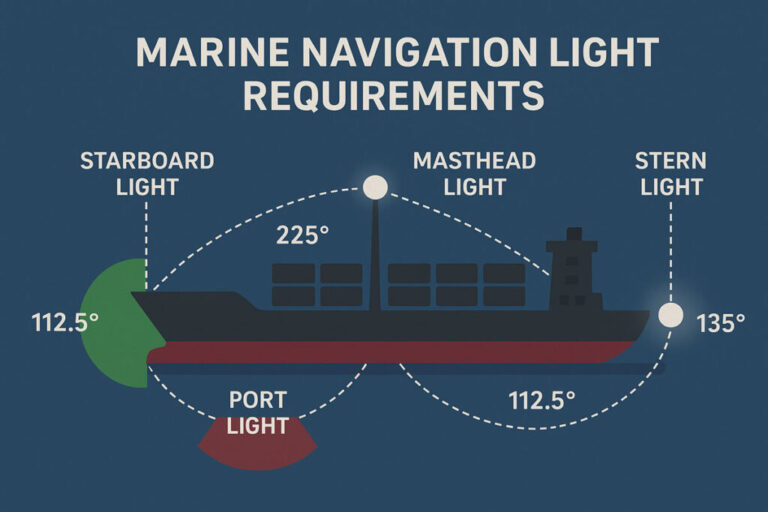
None of this replaces navigation lights. Those exist to be seen. A searchlight exists to see.
How a Searchlight Builds Its Beam
The reflector does the real work.
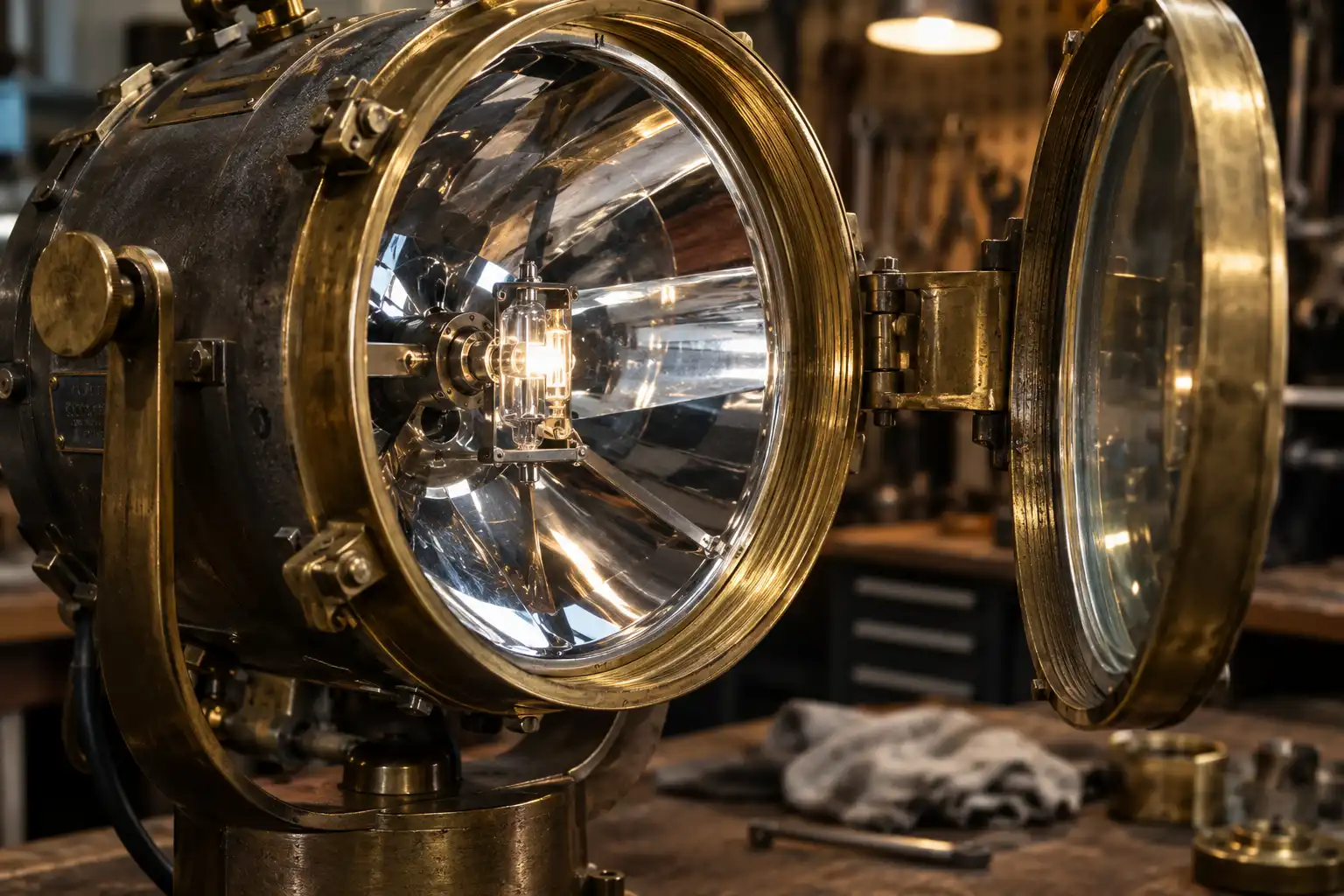
Behind the bulb sits a parabolic mirror, either ground glass or polished aluminum. It gathers light scattering in every direction and turns it into one column. Good aluminum reflectors reach about 95 percent of a glass mirror’s reflectivity.
The bulb sits at the focal point. Move it forward or back and the beam widens or tightens. That focus mechanism separates a searchlight from a fixed floodlight.
Toughened front glass takes the heat and the spray. The drum hangs on a gimbal so one operator swings it through pan and tilt. Housings come in marine grade stainless, brass, or aluminum, and brass tends to outlast aluminum in salt air over a few decades.
Light Sources, Carbon Arc to LED
Four generations, and I have handled all of them.
Carbon arc came first. Carlisle & Finch built the first open arc searchlight in 1895. Those units burned carbon rods that a crew member fed by hand. Bright, filthy, constant work.
Tungsten halogen replaced it and still fills most yards. Francis Searchlights covers 230 mm (9 inch) to 560 mm (22 inch) drums, with lamps from 100 W to 3 kW.
Xenon arc arrived in the 1960s. A 150 W xenon lamp reaches roughly 6 million candela, more punch than a 2 kW halogen from a smaller drum.
LED goes on new builds now. It draws around 75 percent less power than halogen at about twice the output. Most salvage pieces I see are halogen or xenon.
Manual, Cabin Control, and Remote
Three control types, and the difference matters when buying.
Manual units carry a handle on the drum itself. The operator stands on deck and aims by hand. These rewire easily, and they are the ones I point home buyers toward.
Cabin control runs that handle through the deckhead or bulkhead. The operator stays dry inside the wheelhouse while the drum sits out in the weather.
Remote units use pan and tilt motors driven by a joystick on the bridge, usually over an RS485 line. Without the matching control panel, those motors are dead weight.
Where Searchlights Sit on a Ship
Most sit on the monkey island, the open deck directly above the navigating bridge. Bridge wings and the foremast are the other common spots. Height matters. The beam has to clear the bow and any deck cargo.
The Rules That Put Searchlights on Ships
Three sets of rules, and each asks for something different.
The Suez Canal Authority is the strictest. Its Rules of Navigation call for a bow mounted projector on the vessel centerline. The beam has to reach 1,800 m at no less than 3 million candela. That means 2,000 W up to 30,000 Suez gross tons, and 3,000 W above. Since the 2026 change, every transiting vessel supplies its own unit, and a missing or non compliant one draws a 500 USD fine per transit.
The LSA Code covers survival craft. Lifeboats and rescue boats carry a small searchlight. It needs a horizontal and vertical sector of at least 6 degrees, 2,500 candela measured intensity, and 3 hours of continuous running.
SOLAS Chapter V asks for a daylight signalling lamp on ships of 150 gross tons and up. That is the handheld Aldis lamp, built for Morse signalling rather than area search. Both sit apart from the lights a cargo hull must show to avoid collision.
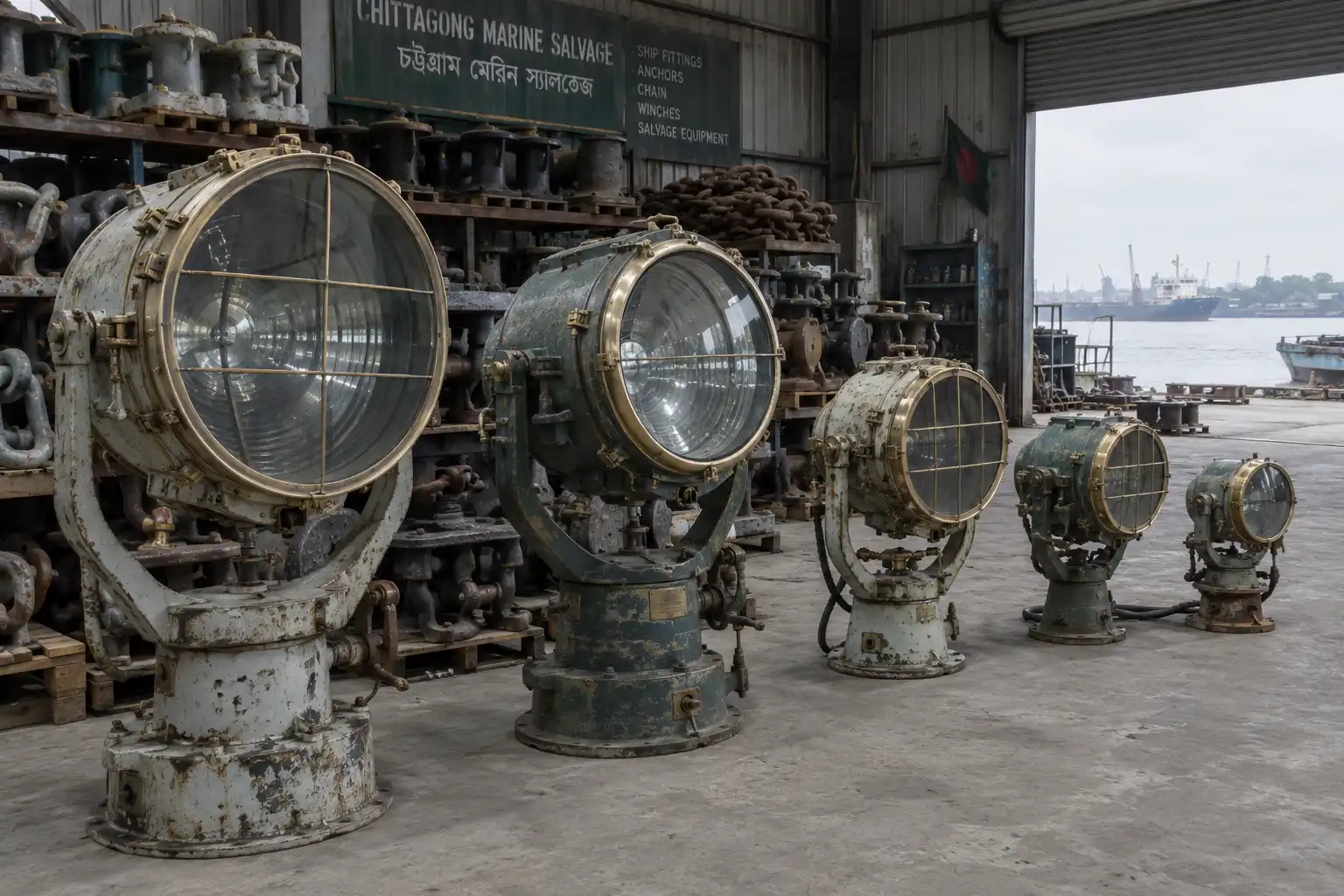
What I Check Before I Buy One
Reflector first. Pitting, clouding, or flaked silvering kills the beam. Glass reflectors chip at the rim.
Front glass second. Hairline cracks come from thermal shock and spread once the lamp heats again.
Then the moving parts. A seized gimbal bearing and a frozen focus screw are both fixable, but they add bench hours.
Check the gasket seat behind the glass ring, because a flattened gasket is exactly how water gets inside a sealed marine fixture and sits there.
Last, read the voltage plate. Ship units run 24 V DC, 110 V, or 220 V, so anything going into a house needs rewiring. The plate also helps with telling a genuine yard piece from a reproduction.
Budget for cleanup too. After thirty years of stack soot and salt, getting oxidation off old brass is slow work.
Final Thoughts
A searchlight is not a subtle fixture. It is heavy, it needs a proper mount, and it takes over whatever wall or floor it lands on. That is the point of it.
If you get to look at one, put your hands on the focus knob and swing the gimbal. Polish comes later. Good hunting.