How to Space Deck Lights Without Dark Gaps or Glare
A customer in North Carolina sent me photos of his new pergola last spring. He had mounted five salvaged deck lights along one beam, barely two feet apart. The wood glowed like an airport runway. His seating area, three feet behind it, sat in the dark. Nothing was wrong with the fixtures. They came off a bulk carrier we cut up in Chattogram. The spacing was the problem, and spacing is the step almost everybody rushes.
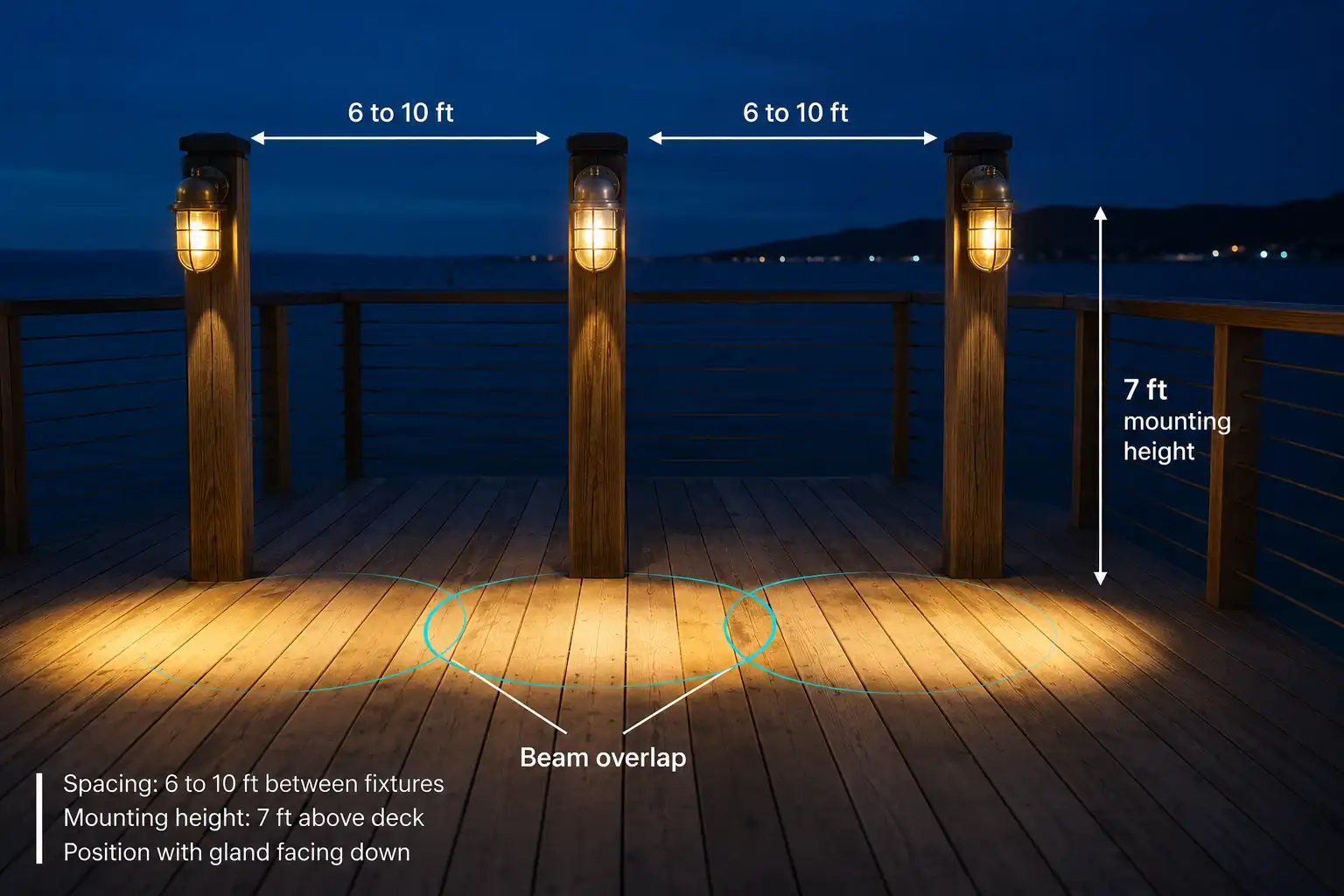
Space deck lights 1 to 1.5 times their mounting height apart. A fixture 7 feet up wants its neighbor 7 to 10 feet away. Tighten the gap for stairs and work zones, and widen it for soft background light.
Learn more: How to Wire Deck Lights the Safe Way
Spacing Follows Mounting Height
Height sets the spacing, not the length of your deck. Light leaves a fixture as a cone. The higher the fixture sits, the wider the pool it lays down.
Lighting engineers use a spacing to mounting height ratio for this. Maximum spacing equals that ratio times the height above whatever surface you want lit.
A ratio of 1.0 to 1.5 covers most jobs. Use 1.0 for grill stations and stair landings. Past 1.5 you start getting dark patches between the pools of light.
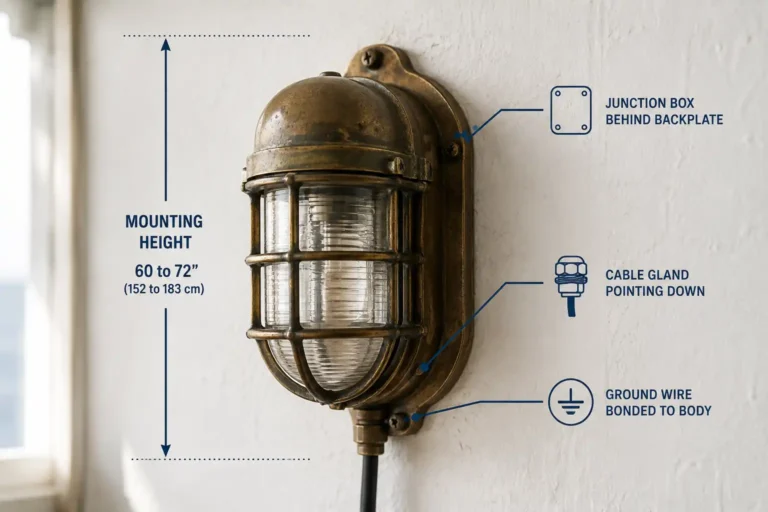
One detail people miss: measure to the surface that matters. If the deck is for dining, measure down to table height, not to the boards. The same thinking drives the mounting height for a bulkhead fixture on a wall.
Do the Beam Math Before You Drill
Beam angle sets the size of each pool. The formula is short. Pool diameter equals 2 times the mounting height times the tangent of half the beam angle.
A 60 degree fixture at 8 feet drops a pool about 9 feet wide. Space your fixtures at roughly 70 percent of that number, so around 6 feet apart. That 30 percent overlap is what removes the gaps.
Old ship floods usually run wider, closer to 100 or 120 degrees. Shallow polished reflectors and plain glass do that. Wide beams let you spread fixtures farther apart, so one salvaged flood can cover a small patio on its own.
Deck Light Spacing Numbers That Work
Here is what I send people by email:
- Railing or post fixtures: 4 to 6 feet apart
- Wall or beam mounted lights near eye level: 6 to 8 feet apart
- Stairs: one light every two or three steps
- Doorways and corners: one fixture each, then space the rest around them
Keep the visible count odd. Three, five, or seven fixtures look settled on a deck. Four or six read as a grid.
Brightness matters as much as distance. Seating areas need only 1 to 2 lumens per square foot. Task zones like an outdoor kitchen want 3 to 5. Most buyers order triple that, then wonder why the deck feels like a parking lot. Deciding where these fixtures work best indoors and outside comes before any of the math.
How Spacing Works on a Working Ship Deck
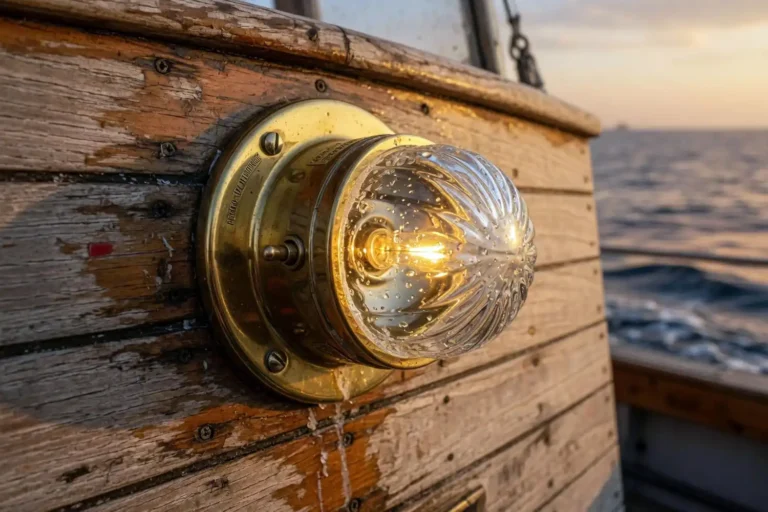
Aboard ship the goal is flat, even coverage. That is the job these old shipboard fixtures were built for. Marine lighting guidance puts open deck areas near 50 lux on average, with a color rendering index above 80. Crew have to read colors on cargo gear and hoses, so the light has to be honest.
Fixtures get placed so the beams overlap across the whole work area. Cranes, hatch coamings, and winches throw long shadows, so the layout works around obstructions instead of around symmetry.
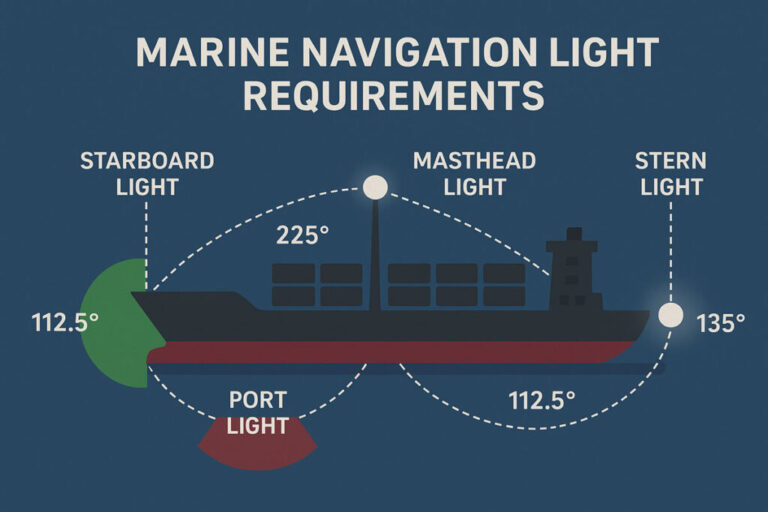
Two rules shape the placement. COLREG Rule 20(b) allows no extra light that impairs the prescribed lights or interferes with keeping a proper look out. Annex I also states sidelights must not sit so low that deck lights interfere with them. If you want the wider picture, read up on light requirements for cargo ships.
There is one more worth knowing. Under Rule 30(c), a vessel of 100 meters or more at anchor has to light her decks with available working lights.
Salvaged Fixtures Change the Math
Original lamps ran hot and yellow. A modern LED retrofit can double or triple the output from the same housing, so old spacing turns glary fast. Check the lumens on the lamp, not the wattage on the tag.
Weight decides a lot too. Cast brass and steel housings need a stud, joist, or blocking behind the backplate. I have watched perfect 6 foot spacing shift to 5 foot spacing because that is where the framing was.
Glass condition affects reach as well. A pitted or fogged lens scatters light and shrinks the useful pool. Clean the lens and check the gasket before you measure anything. Water sitting inside a vintage deck lamp ruins both the beam and the fitting.

Test the Layout at Night First
Paper plans fail outdoors. Clamp each fixture in place, run a temporary cord, and switch everything on after dark.
Then sit down. Look at the deck from the chairs people actually use, not from the doorway. Your eyes need about twenty minutes to settle into low light, so give it time before you judge.
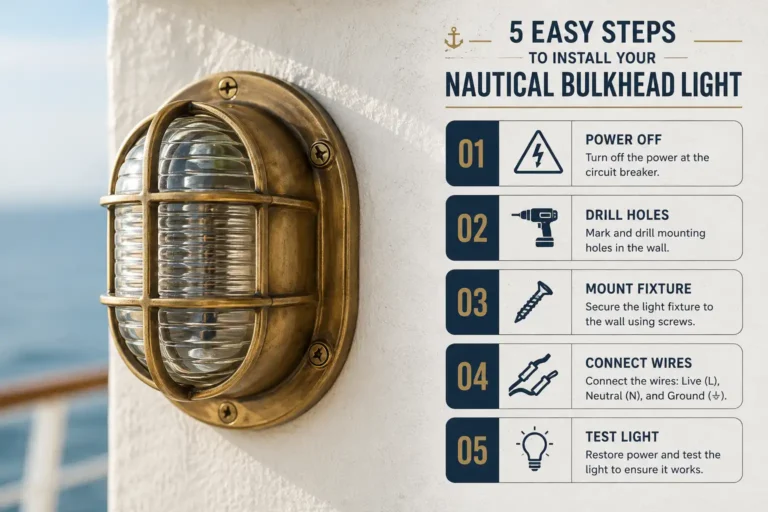
Move any fixture that shines into a sightline. Add one where the boards go black. Only then should you drill, and only after you have sorted out wiring an old marine fixture safely.
Final Thoughts
Good spacing is quiet work. Nobody walks onto a deck and praises the gaps between the lights, but they feel it when the layout is right.
Start with mounting height, keep the pools overlapping by about a third, and test after dark. The fixtures I sell were built for a steel deck in a gale, so they will forgive a lot. Bad spacing is the one thing they cannot fix on their own.
Take your time with the tape measure, and enjoy the evenings.