How Do Ship Searchlights Work? A Look Inside the Housing
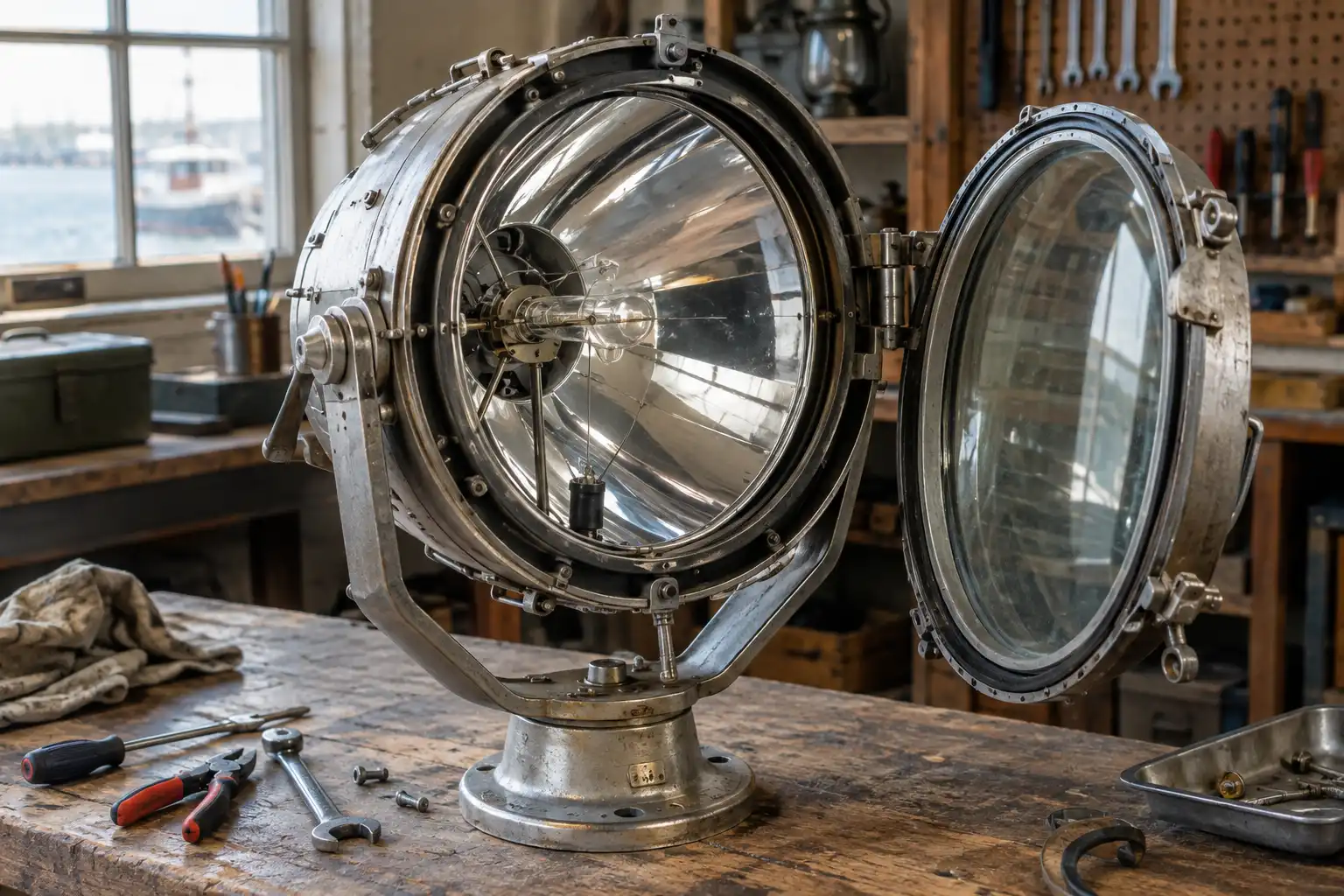
The first searchlight I pulled off a scrapped bulk carrier weighed more than my toolbox. I got it back to the workshop, cracked the front ring open, and just stared at the mirror inside. Silver, curved, still spotless after twenty-odd years at sea. That mirror is the whole trick. Most people assume the bulb does the work. It doesn’t.
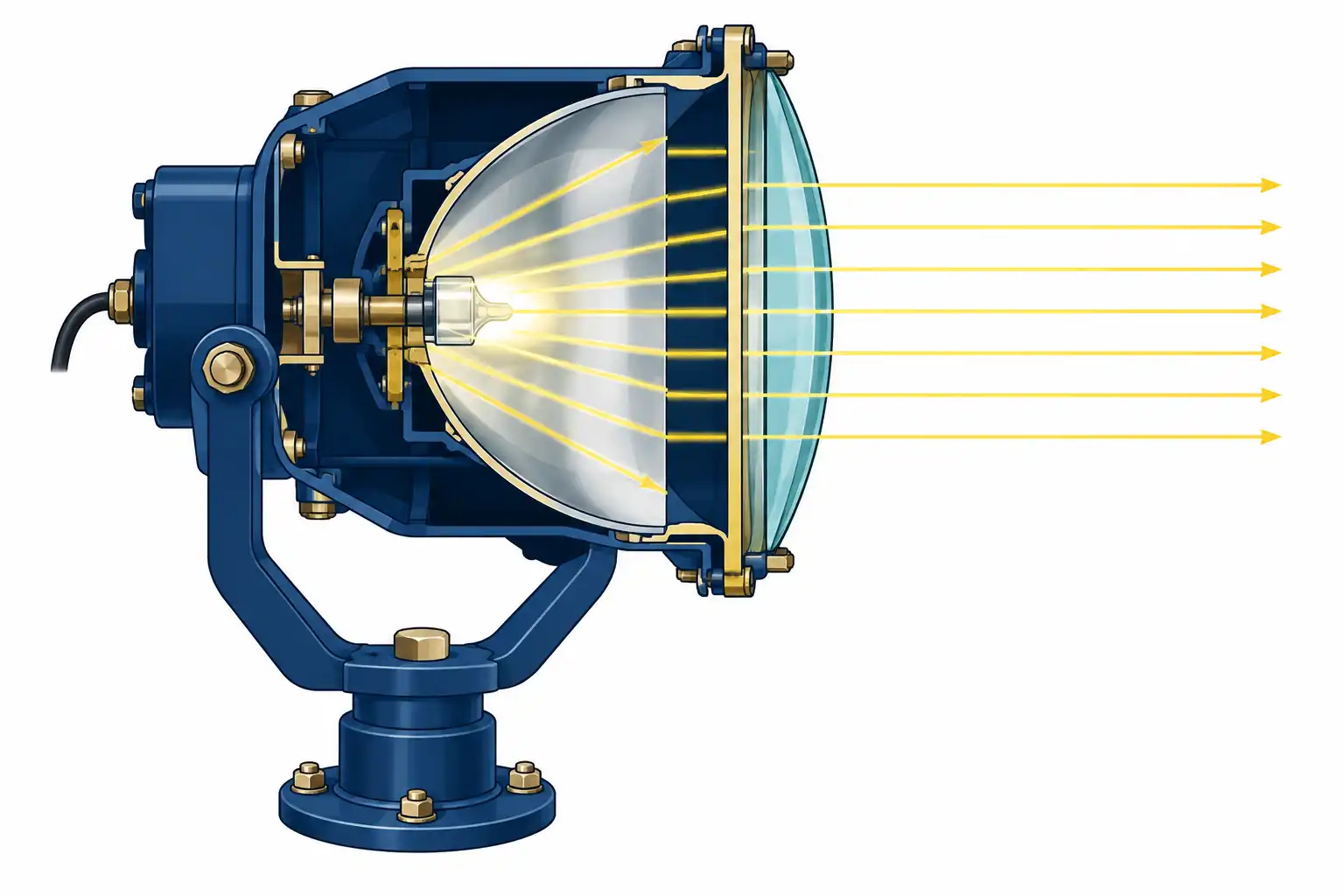
A ship searchlight puts a very bright lamp at the focal point of a parabolic mirror. The mirror catches light heading in every direction and turns it forward into a narrow, almost parallel beam. That beam stays tight over long distance instead of spreading out the way a floodlight does.
What Is Inside a Ship Searchlight
The lamp
Older units run a tungsten halogen or incandescent focus bulb in an E40 screw holder. Ratings go from 250W up to 3000W. Larger vessels used xenon arc lamps, which strike a small, fierce arc between two electrodes. A xenon arc behaves more like a single point of light than a filament does, and that matters enormously to the mirror.
The reflector
The reflector is a parabola, and a parabola has one useful property. Every ray leaving the focal point bounces off the surface travelling dead ahead. Good units use silver coated glass instead of polished aluminum. Silver reflects more light and survives the heat better.
The glass and housing
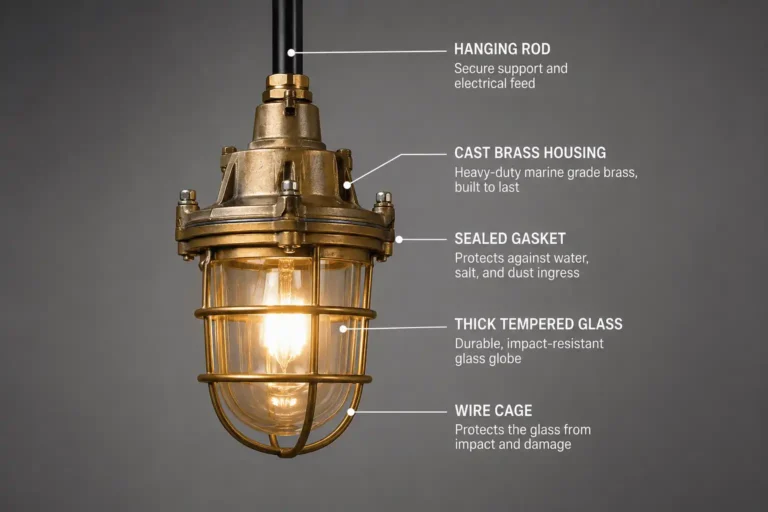
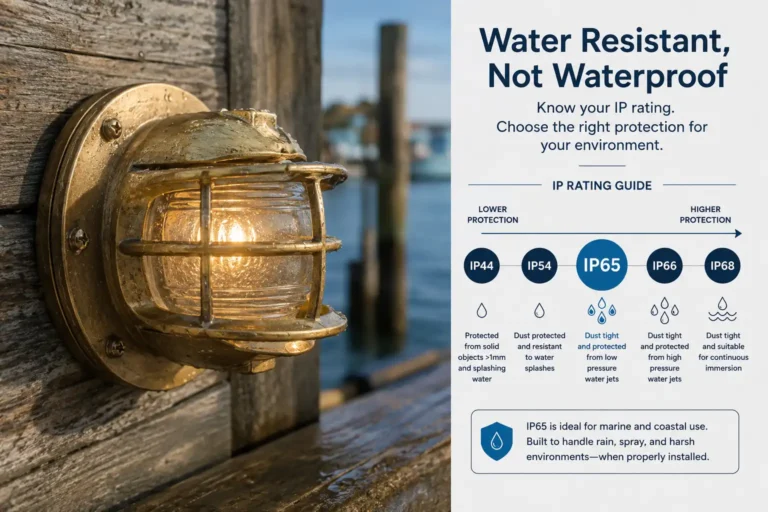
Toughened front glass seals the optics in. Bodies are steel, stainless, or aluminum alloy, with silicone or neoprene gaskets at every joint. Most commercial searchlights carry an IP56 rating, meaning dust protected and safe against heavy water jets. It is the same sealing logic behind why proper marine fittings keep salt water out.
How the Beam Gets Aimed
A searchlight is no use if you can’t point it. Two systems handle that.
Older ships used a mechanical lifter. A rod and handle drop through the deckhead into the wheelhouse, so the mate swings the light by hand from inside, out of the weather. Typical travel is 350 degrees horizontally, about 20 degrees up and 50 degrees down.
Newer units use motors and a joystick on the bridge console. Same movement, no linkage to seize up.
Spot or Flood: The Focus Adjustment
Nearly every marine searchlight lets you slide the lamp toward or away from the mirror. Sit it exactly on the focal point and the beam tightens to roughly 6 degrees. Pull it off focus and the beam opens into a wash.
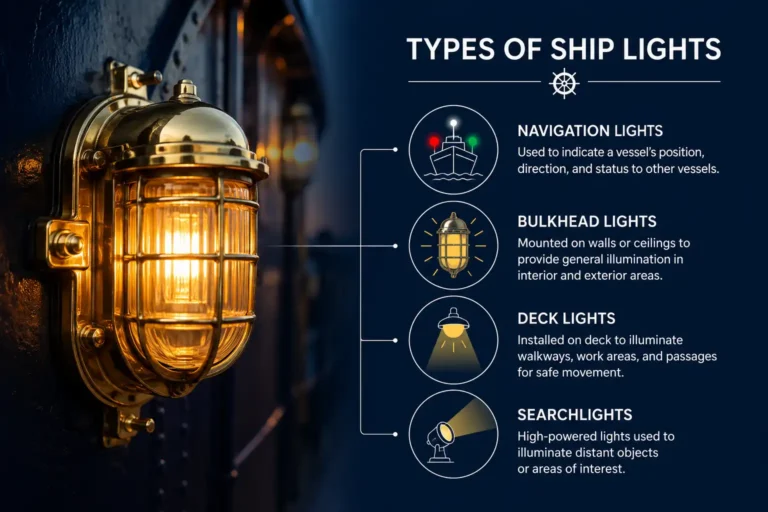
Crews use the tight setting to pick out a buoy a mile off. They use the wide setting to light the water alongside, much the way deck lights cover a working area rather than reaching for distance.
Power, Wattage, and Throw
Ship searchlights run on the vessel’s own power. Common ratings are 24V DC, 110V DC, and 115V or 230V AC.
Wattage follows the job. A 300W halogen unit suits a workboat. A 1000W unit throws usable light past 1,200 meters. A 3000W xenon reaches several kilometers in clear air. Big lamps pull serious current, so they sit on their own circuit with their own breaker.
What Crews Actually Use Them For
Searchlights do four jobs at sea.
They find things: buoys, channel markers, small craft, floating debris, and people in the water. They light the pilot ladder during a night transfer. They back up anti-piracy watches in high risk waters. And they signal.
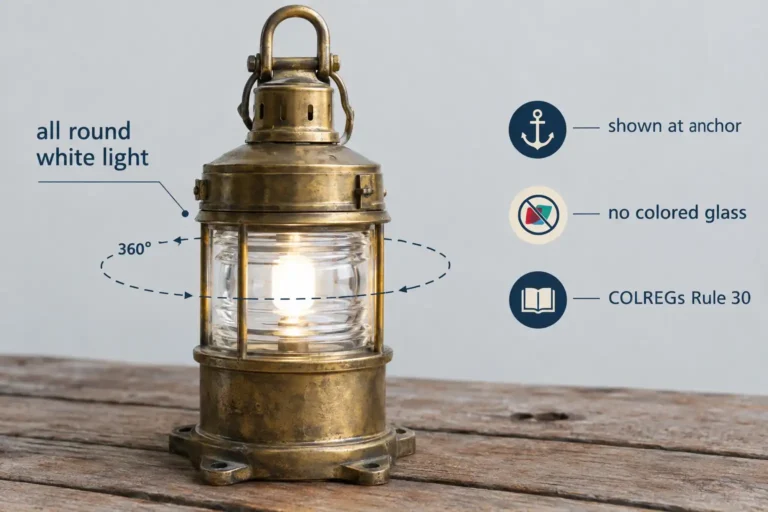
Signalling is its own category. SOLAS Chapter V requires ships of 150 gross tonnage and upwards to carry a daylight signalling lamp. Its power source cannot depend solely on the ship’s mains. That’s the Aldis lamp: a handheld searchlight with a trigger shutter for Morse. It sits alongside the carriage rules covering navigation lights on cargo ships as core bridge equipment.
From Carbon Arc to LED
Carbon arc searchlights showed up around 1870. Carlisle & Finch of Cincinnati built their first open arc searchlight in 1895 and were supplying the US Navy shortly after. Carbon rods burned away as they ran, so someone had to keep feeding them.
Xenon took over from the 1960s. LED now handles most short and mid range work because it draws less power and lasts far longer. For serious long throw, xenon still wins on raw brightness per square millimeter of source.
Buying a Salvaged Ship Searchlight
Most of what comes through our yard in Chattogram is 1970s to 1990s stock. TG and TZ series housings, Den Haan Rotterdam units, Glamox and Wiska bodies, plus older brass military types.
Check three things. Is the reflector still bright and unpitted, or has it gone cloudy? Is the front glass original and uncracked? Do the pan and tilt joints move without a fight?
The bulb rarely matters, since E40 and GY9.5 lamps are still stocked everywhere. Fitting one for domestic power is simple electrician work, and the basics match rewiring any old marine fixture for household supply. If you want it mainly as a display piece, read up on spotting a genuine shipboard fitting from a reproduction first.
Final Thoughts
A searchlight is one of the few ship fittings that still looks like what it does. Big mirror, heavy yoke, honest engineering, nothing hidden. Wire one up on a wall or a porch and it keeps every bit of that.
Good luck with yours.