What Are Searchlights Used For on Ships? A Salvage Dealer Explains
Last month I cut a 350mm searchlight off the port bridge wing of a bulk carrier at Bhatiari. The barrel still swung clean on its yoke after decades at sea. My buyer in Oregon wanted it for a covered porch, and he asked me what the thing had actually done for a living. Good question. A searchlight is the one light on a ship that somebody aims by hand. Every other fitting sits in place and glows.
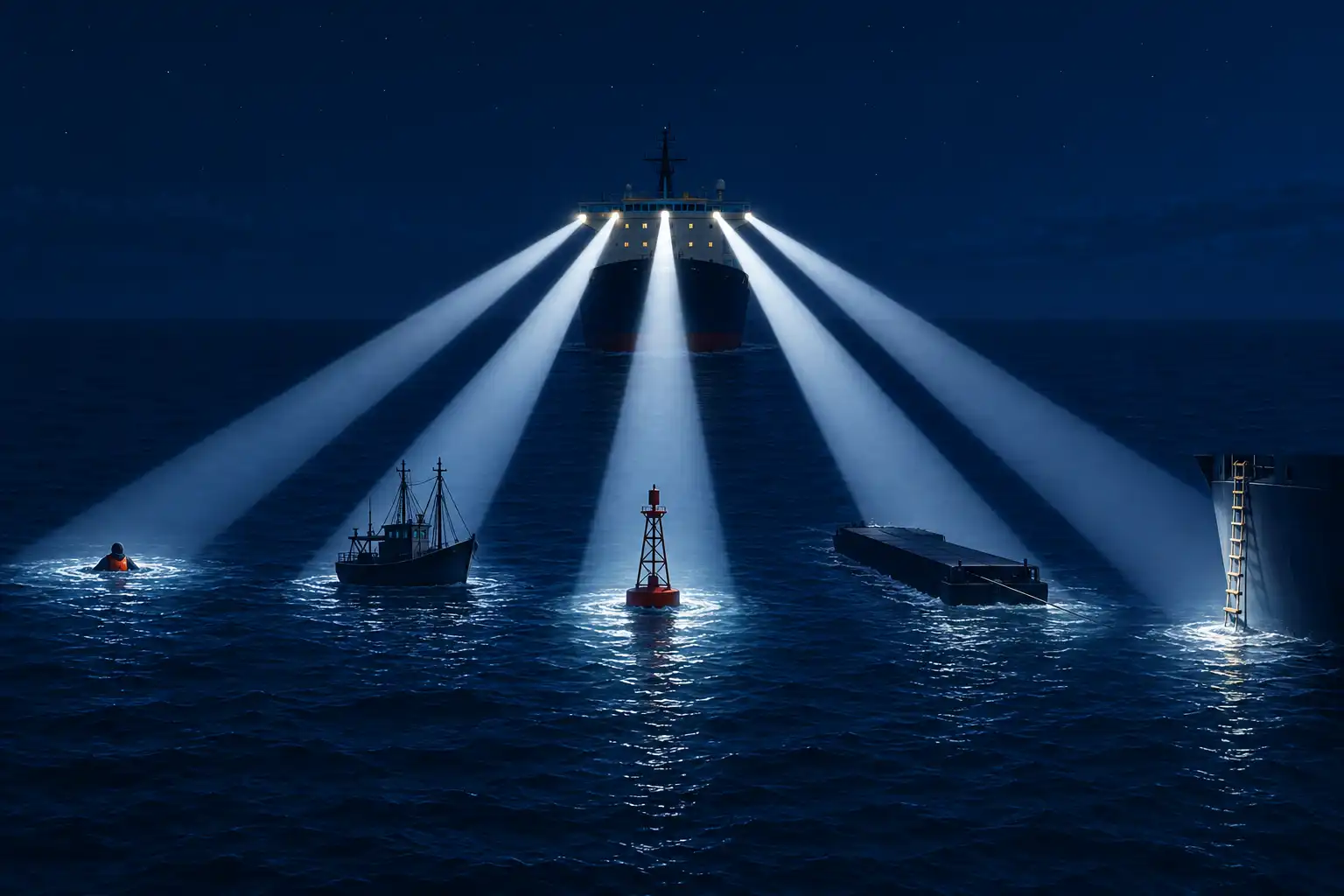
Searchlights light up whatever a ship’s fixed lights cannot reach. Crews aim them at man overboard searches, unlit buoys, floating hazards, mooring gear, pilot ladders, tow lines, and small craft closing on the hull. The beam moves on command, and that is the whole point of carrying one.
The Jobs Searchlights Are Used For on Ships
Finding a person in the water
Man overboard is the job that justifies the fixture. A head in the water reads as a dark dot against dark sea. Deck floodlighting spreads too wide to pick that out at any distance.
A searchlight throws a tight column instead. The officer sweeps it slowly across the search pattern while the rescue boat launches.
The IMO Life-Saving Appliance Code writes the requirement down. A rescue boat carries a searchlight covering at least 6 degrees horizontally and vertically. It measures 2,500 candela and runs three hours straight.
Spotting what radar misses
Radar does not see everything. Small wooden fishing boats, half-sunk logs, drifting containers, and low ice all sit below a useful return. In the Bay of Bengal I have watched crews pick out unlit country boats with a beam alone.
Searchlights also find unmarked channel buoys in tight water. The light requirements a cargo ship has to meet cover what a vessel shows to others. A searchlight covers what she needs to see.
Warning another vessel
COLREGs Rule 36 puts the searchlight in the rule book. A vessel may aim her beam toward the danger to get attention, provided she does it in a way that does not embarrass anybody else. Strobes and revolving lights are ruled out.
One point gets muddled often. A searchlight is not a daylight signalling lamp. SOLAS Chapter V makes ships of 150 gross tonnage and upwards carry a separate signalling lamp. Its power source cannot depend only on the ship’s supply. That is the Aldis lamp, and it sends Morse. The searchlight illuminates.
Lighting deck work and tows
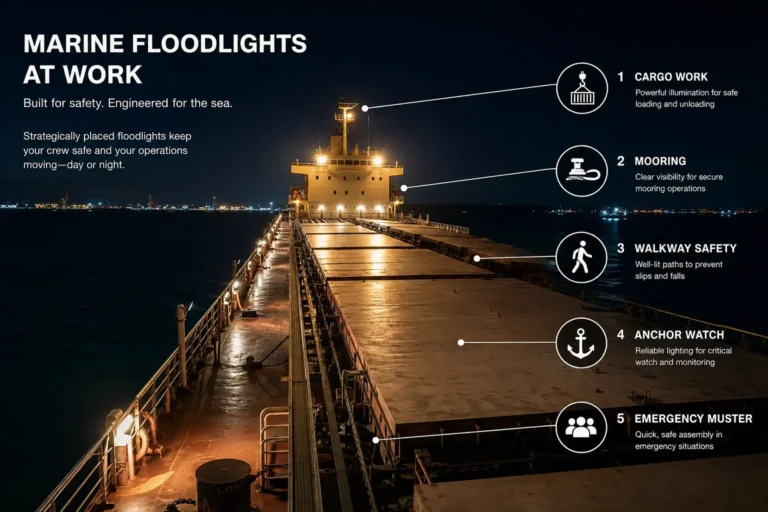
Mooring stations, anchor cables, and pilot ladders all need light the fixed fittings cannot throw over the side. That is where the beam earns its keep, alongside the fittings that cover working areas on deck.
Towing sits in the rules too. Rule 24 allows the Rule 36 searchlight to illuminate the tow line and the vessel being assisted, so other traffic reads the connection correctly.
Keeping small boats off the hull
Since the piracy years off Somalia, high-power searchlights have become standard security kit. A xenon or high-output LED beam on a skiff at night blinds the people in it and tells them they have been seen.
Where They Sit and How They Are Aimed
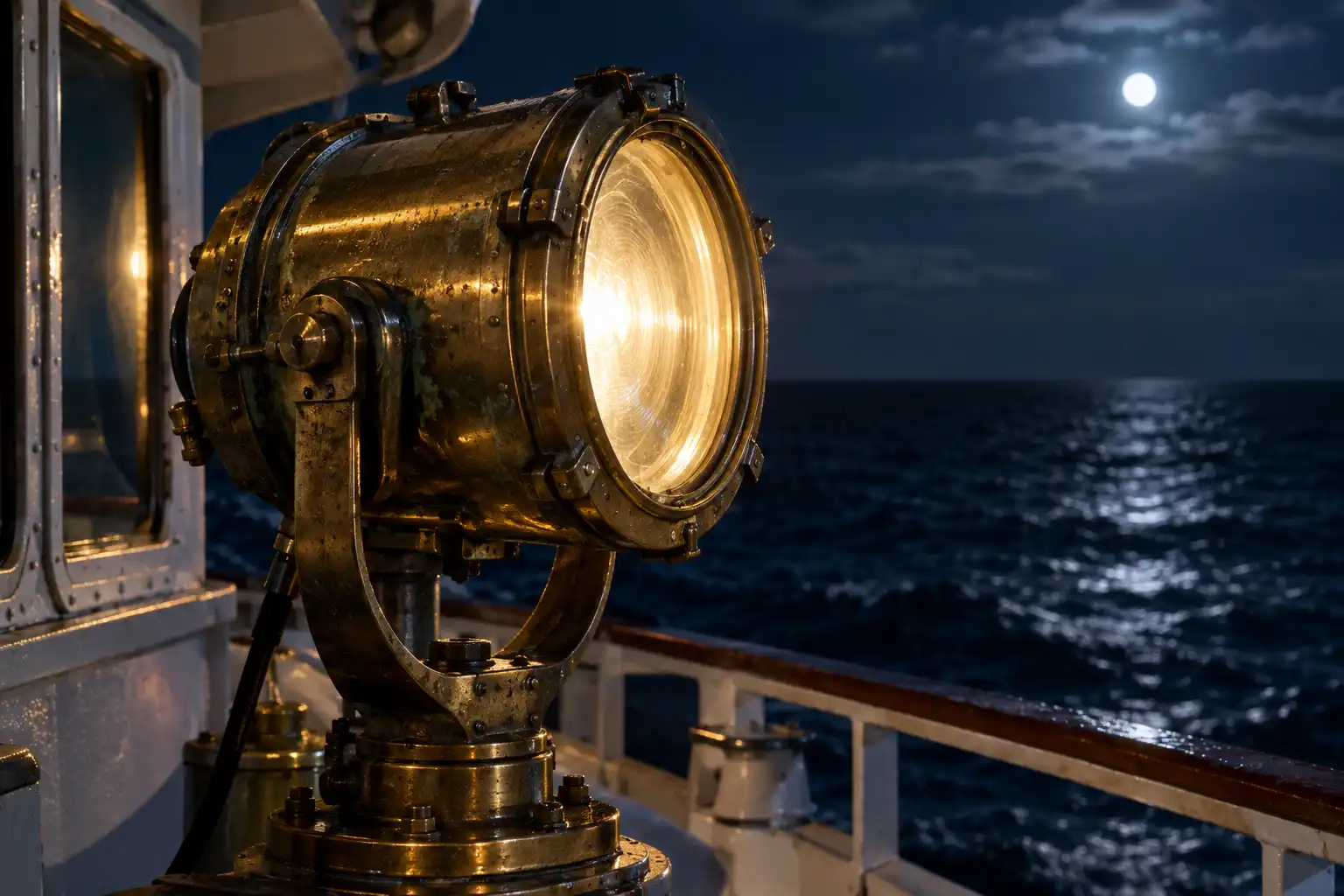
Most merchant ships carry one on each bridge wing. Some add another on the monkey island. Canal work puts one at the bow.
Older units are aimed by hand, with a yoke and a handwheel, and the operator stands out in the weather. Newer ones are motorised and run from a joystick inside. Barrels run from roughly 180mm on small craft up to 710mm on the big canal units.
When the Rules Demand One
The Suez Canal is the clearest case. The Suez Canal Authority requires a projector on the centreline at the bow. It has to throw a usable beam 1,800 metres ahead at no less than three million candela. Ships up to 30,000 Suez gross tons need the 2,000 watt equivalent, and larger ships 3,000 watts. Tankers and gas carriers need gastight cable and sockets.
Fail the inspection and the ship transits in daylight only. That costs a convoy slot and real money.
From Carbon Arc to LED
Carlisle & Finch of Cincinnati built its first open arc marine searchlight in 1895, and carbon arc ruled for decades after. Francis Searchlights of Bolton has been making them since 1901. Both names still turn up on housings in our yards.
Tungsten halogen took over mid-century. Carlisle & Finch pioneered xenon arc in the 1960s, and xenon still wins on raw throw. A 15 inch xenon unit at 500 watts puts out around 35 million candlepower and reaches about three nautical miles.
LED has closed most of that gap. A 234 watt LED now matches a 300 watt xenon lamp, with roughly 20,000 hours of life behind it.
What I Check Before I Buy One
Bearings first. If the yoke will not swing, it is either scrap or a long rebuild.
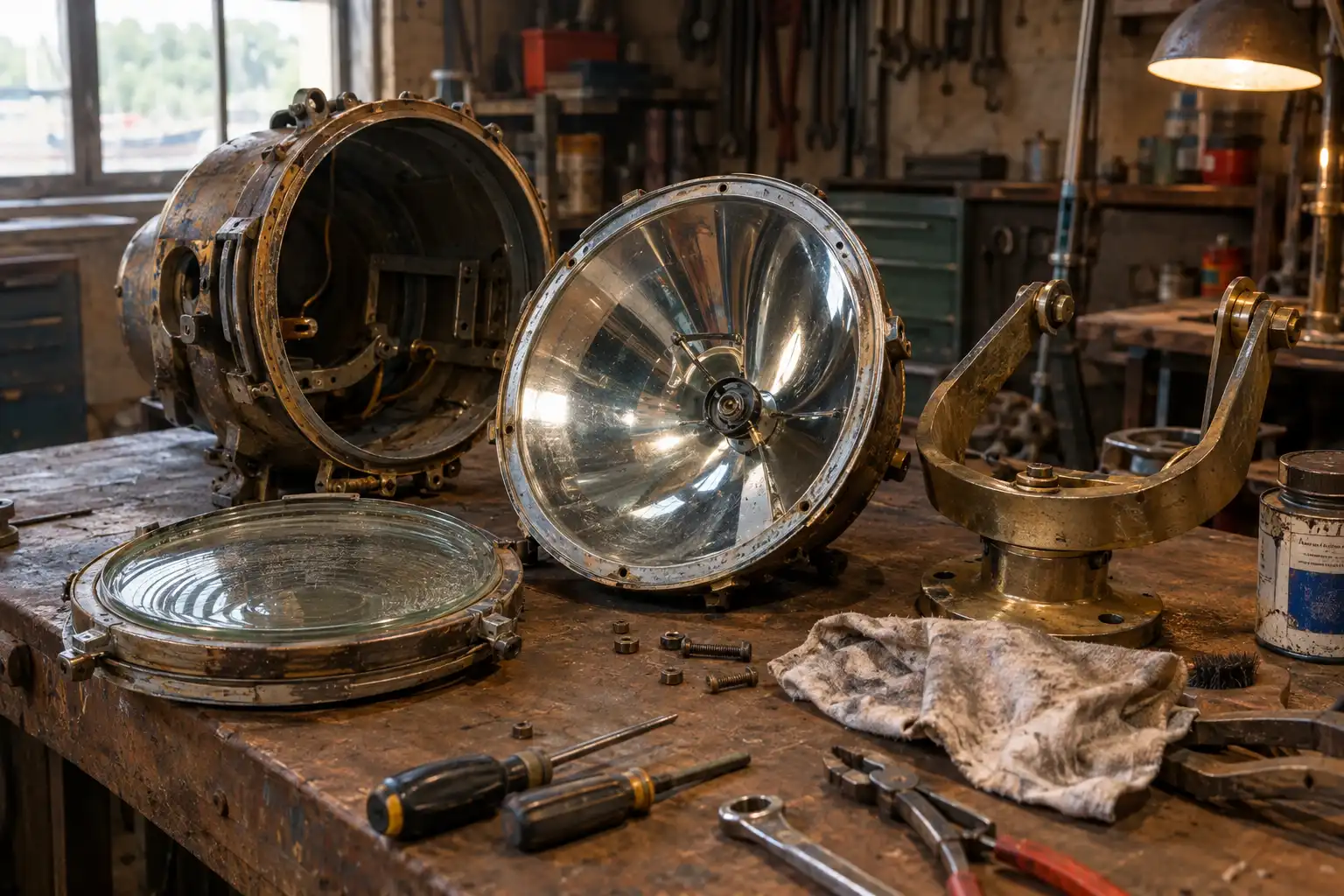
Then the reflector. Canal units split into two halves, and pitted aluminium never comes back properly. Glass is easy to replace. The barrel matters as well, since brass and aluminium housings age differently once a fixture leaves the sea.
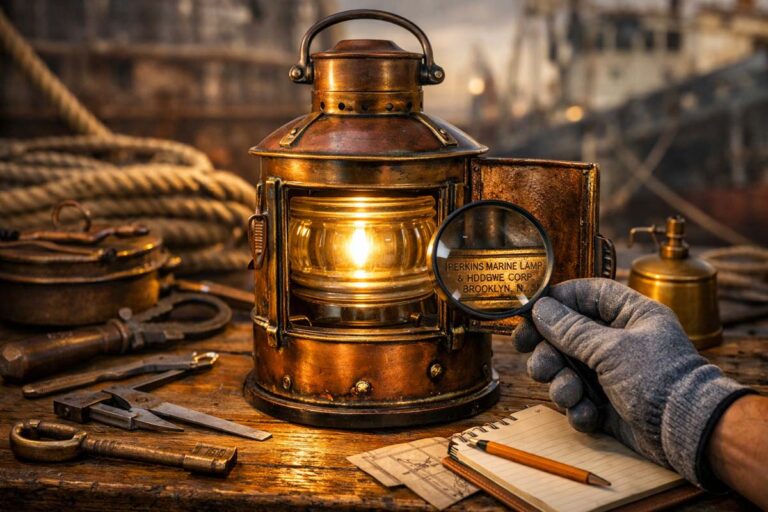
Provenance is the last thing. Plenty of reproduction spotlights get sold as marine salvage, so I use the same checks as telling a genuine old fixture from a copy. Real ones carry cast maker’s plates, heavy bronze yokes, and honest corrosion.
Final Thoughts
Every searchlight I pull down has pointed at something that mattered. A man in the water. A fishing boat with no lights. A canal bank at two in the morning.
That history is most of why people want one on a wall. If you buy a salvaged unit, check the bearings, keep the original glass, and enjoy it.