How Far Can a Ship Searchlight Reach
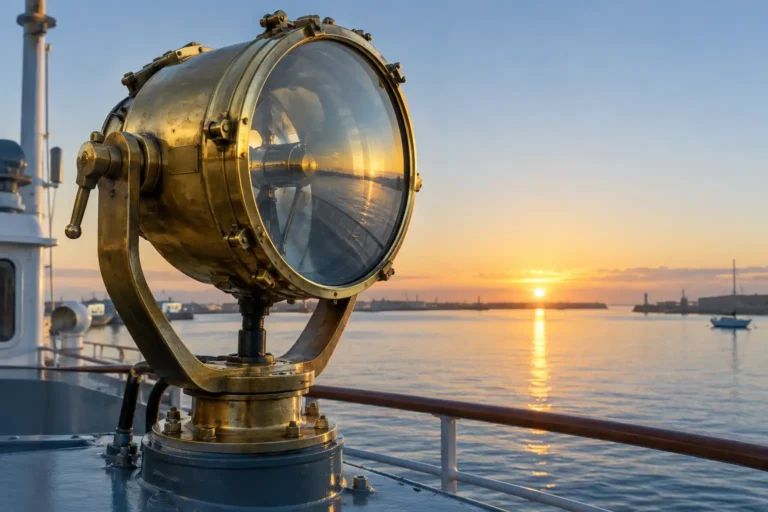
A buyer in Texas rang me about a 300 mm Francis unit I had just pulled off a bulk carrier. His first question was not the price. He wanted to know how far it would throw. I gave him a number. Then I gave him the longer answer, because one number is how people end up disappointed. Reach depends on the lamp, the reflector, the weather, and how high the light sits above the water.
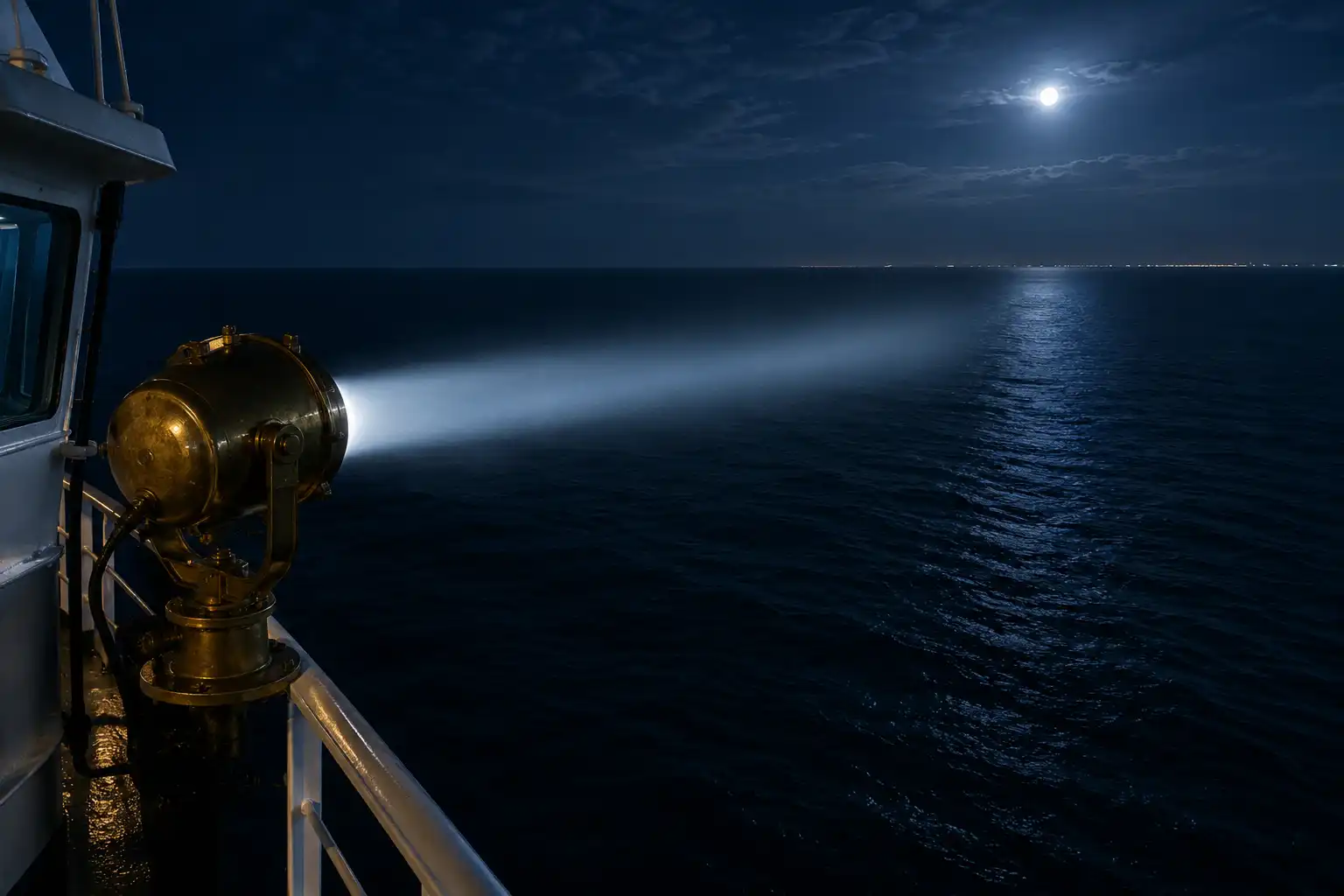
Most ship searchlights put usable light on a target between 500 and 5,000 meters, or roughly 0.3 to 2.7 nautical miles. A 1,000 watt halogen unit covers about 1,400 meters on a clear night. A 350 watt xenon unit reaches close to 5,000 meters.
What “Reach” Means on a Spec Sheet
Reach is never one number. Makers publish it two different ways, and the gap between them is huge.
The first is the distance at 1 lux. That is bright enough to pick out a life raft, a buoy, or a hull number. You find it by taking the square root of the beam candela. A 25 million candela xenon gives 5,000 meters.
The second is ANSI FL1 beam distance, measured at 0.25 lux. That is about the brightness of a full moon. You see a shape, not a detail. It works out to exactly double the 1 lux figure.
So the same lamp can be sold as a 5,000 meter light or a 10,000 meter light. Both are accurate. Always check which threshold the brochure used before you compare two units.
Typical Reach by Lamp Type
These are 1 lux figures on a clear night, which is the honest working range.
- Small halogen, 100 to 250 watt, 230 mm barrel: 300 to 700 meters
- Large halogen, 1,000 to 2,000 watt, 300 to 400 mm barrel: 1,100 to 2,400 meters
- LED, 220,000 to 720,000 candela: 470 to 850 meters
- Metal halide, 350 watt: 1,500 to 2,500 meters
- Xenon short arc, 350 watt, 25 million candela: about 5,000 meters
Xenon wins on distance every time. Perko rates its 1,600 watt xenon at over 100 million candlepower and 5.5 miles. Most of the searchlights I recover from the breaking yards here are halogen, because merchant ships rarely needed more.
Mounting Height Sets the Hard Ceiling
Here is the part nobody prints on the box. Your beam cannot light water it cannot see.
Distance to the horizon in nautical miles is roughly 2.08 times the square root of your height in meters. A wheelhouse 10 meters up sees 6.6 nautical miles of sea. A cargo ship bridge wing at 20 meters sees 9.3.
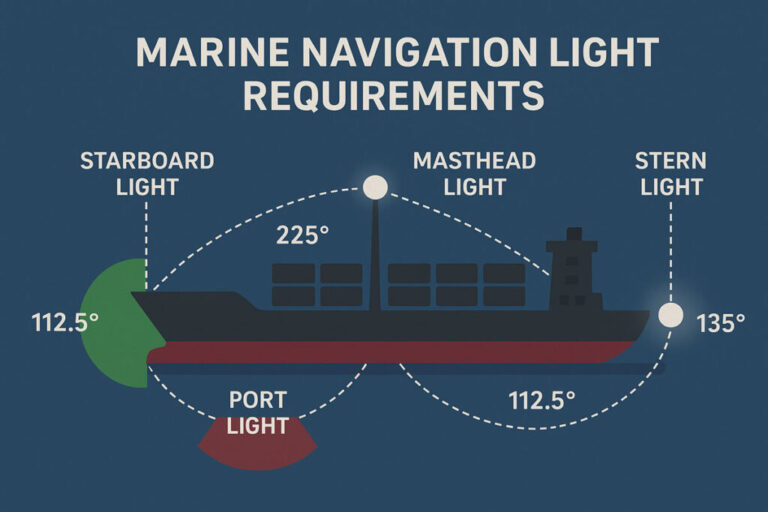
Past that, the sea surface has dropped below the curve. The beam keeps traveling. It just passes over the top of the water. That geometry is why nobody builds a 20 mile searchlight. It also explains why the navigation light rules cargo ships follow are written around being seen, not seeing.
Beam Angle Trades Reach for Coverage
A tight beam throws far and lights almost nothing. A 5 degree beam covers a circle 87 meters wide at 1,000 meters. Open it to 10 degrees and you get 175 meters of coverage at the same range, but the intensity drops off much sooner.
This is why good searchlights have a focus mechanism. Suez Canal units run wide, around 10 by 8 degrees, because the crew needs the bank in view.
What Kills Range in Practice
Every published figure assumes clear air. Real nights are not clear.
Fog is the worst offender by far. A beam rated for 1,000 meters can drop under 100 meters in thick fog, and the backscatter glares straight back at you. Heavy rain and sea spray do the same thing on a smaller scale.
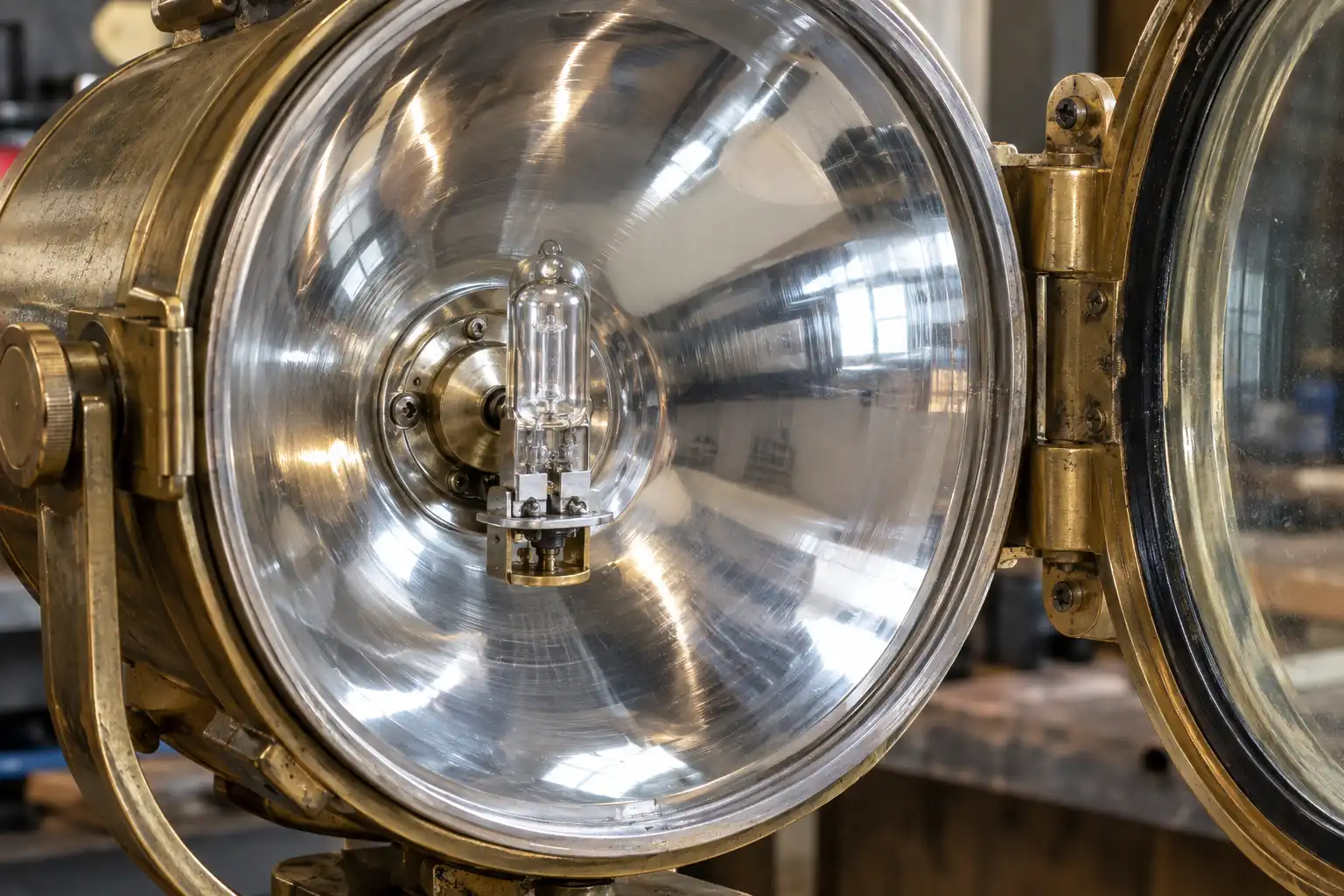
Salt film on the front glass scatters light before it ever leaves the housing. A dull or pitted reflector costs you more than a weak bulb does, since the reflector is doing most of the work. A lamp sitting slightly off the focal point widens the beam and guts the throw.
Sealing matters here too. Once moisture gets in, the reflector clouds, which is the same reason people ask whether marine fixtures are truly waterproof before mounting them outdoors.
What a Salvaged Searchlight Actually Does
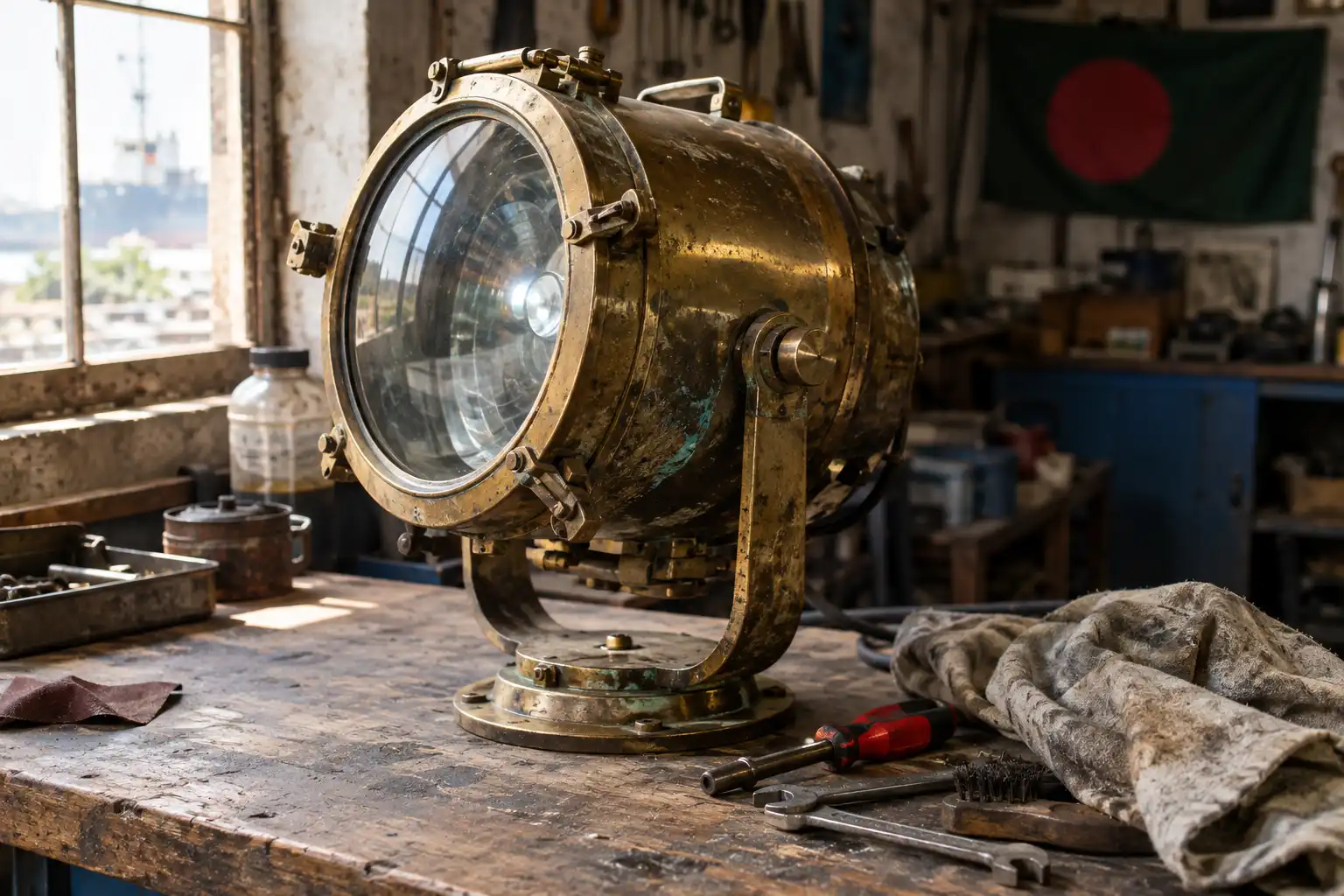
Reflector condition decides everything on a used unit. I open every barrel before I quote on it.
A 1970s or 1980s halogen searchlight with a clean reflector, a fresh lamp, and correct focus gives 800 to 1,500 meters. That is plenty for a dock, a driveway, or a boathouse. Most of my buyers never point one at the sea at all.
If the reflector is tarnished, a proper cleaning of the brass and the optics brings a surprising amount of it back. Pitted aluminum reflectors do not recover, and I say so before money changes hands.
Final Thoughts
Ask any seller for the lux threshold behind their distance claim. If they cannot tell you, the number means nothing. And remember that a searchlight is built to see, while an anchor lantern hung on a forestay only needs to be seen. Two different jobs, two different sets of numbers.
Buy for the reflector, not the wattage. Good luck out there.