How Bright Is a Ship Searchlight? Candela, Watts and Range
Last winter a buyer in Oregon wanted proof before he paid. He asked me to fire up a 1000W xenon unit sitting in my yard. We hauled a generator to the gate after dark and switched it on. The beam hit a crane boom almost a kilometer down the shore and lit the rust like it was noon. He paid that night. But his first question is the one I get on nearly every searchlight inquiry, and most sellers answer it wrong. They quote watts. Watts tell you what the lamp eats, not how far it throws.
A ship searchlight produces roughly 400,000 to 177 million candela at the center of its beam. A common 1000W halogen unit on a cargo vessel sits near 3 to 5 million candela and lights a target about 2,000 meters out. Xenon models on icebreakers and cutters reach 80 million candela and beyond.
Candela Is the Number That Matters
Three units get mixed up constantly. Only one answers a brightness question about a beam.
Lumens measure total light leaving the lamp in every direction. Candela measures intensity at the brightest point of the beam. Watts measure electricity consumed.
A searchlight exists to squeeze light into a narrow cone. A 400W LED head rated 30,000 lumens can out-throw a 2000W halogen if its reflector is tighter and its beam angle narrower. Wattage says nothing about reflector quality or beam spread.
So ask for candela. Every serious manufacturer publishes it, usually as peak beam intensity. If a seller only reads you the wattage off the nameplate, they have not tested the fixture.
Brightness by Lamp Type
Here is what I see stamped on real units coming out of the breaking yards.
| Lamp type | Power | Peak beam intensity | Range at 1 lux |
|---|---|---|---|
| LED, small craft | 30 to 60W | 100,000 to 720,000 cd | 320 to 850 m |
| LED, commercial | 165 to 400W | 1.5 to 4 million cd | 1,250 to 2,000 m |
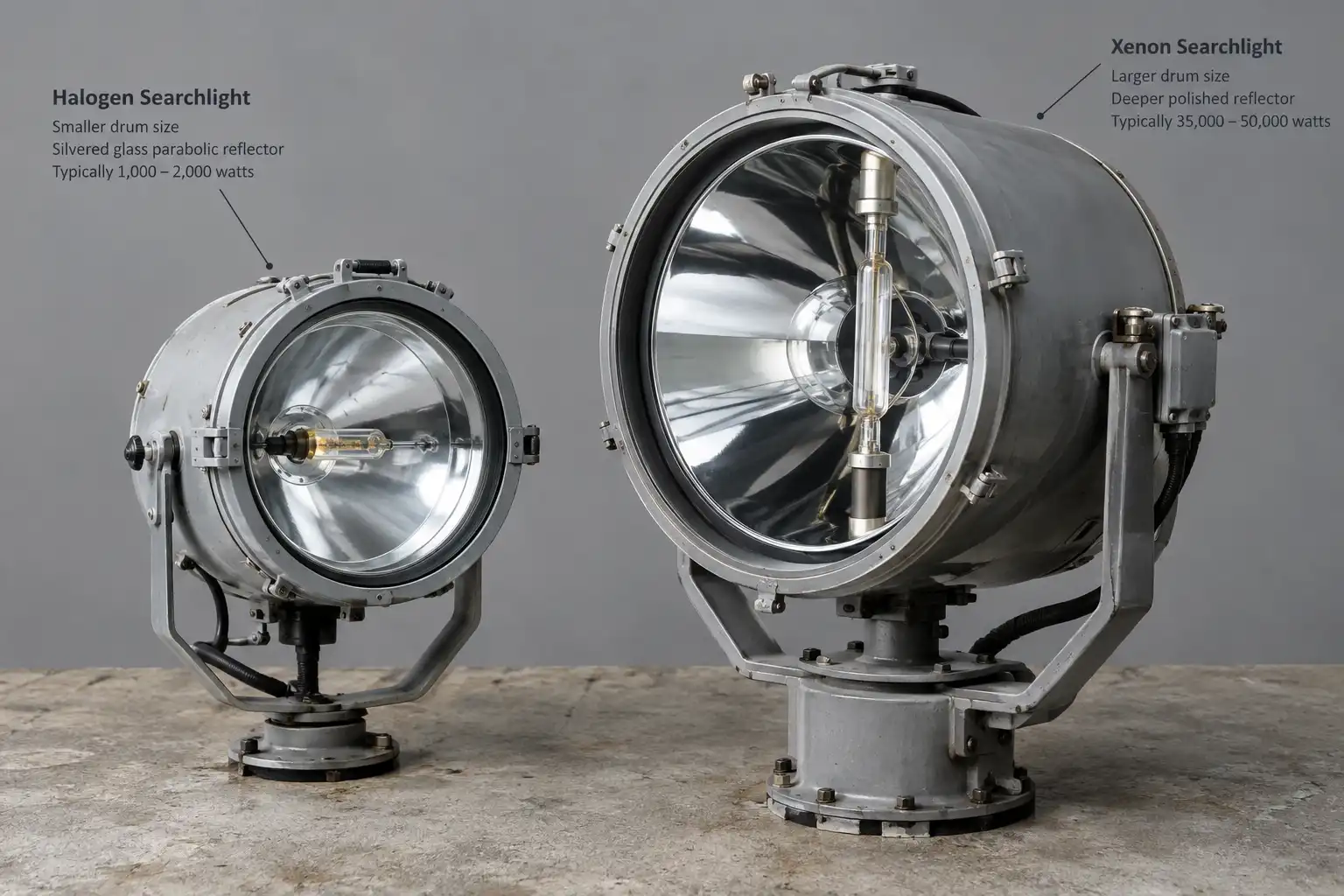
| Halogen | 500 to 2000W | 0.4 to 5.6 million cd | 630 to 2,366 m |
| Xenon | 1000 to 1600W | up to 52 million cd | about 7,400 m |
| Xenon, large drum | 2500W | 177 million cd | about 13,300 m |
Reflector diameter drives most of that spread. A 12 inch halogen drum and a 24 inch halogen drum can pull the same current and differ fourfold in throw.
How Beam Range Is Calculated
Take the square root of the candela rating. That gives you the distance in meters where the beam drops to 1 lux.
A 5.6 million candela halogen works out to 2,366 meters. Its maker publishes 2,366 meters. An 80 million candela xenon works out to 8,944 meters, and that is the exact figure in the catalog. The math is not marketing. It is the inverse square law.
One trap sits in the fine print. Consumer marine brands often rate beam distance at 0.25 lux under the ANSI FL1 flashlight standard, which is about full moonlight. That convention doubles the printed number. A 460,000 candela LED spotlight advertised at 1,372 meters reaches 678 meters by the 1 lux measure used across commercial shipping. Same fixture, two rulers. Check which one before you compare two lights.
Why Three Million Candela Is a Hard Floor
Suez Canal Authority rules set the real minimum for merchant ships. A vessel transiting must carry a bow searchlight producing at least 3 million candela in a single beam, reaching 1,800 meters at 1 lux. The rules put that as equivalent to a 2,000W high efficiency incandescent lamp for ships up to 30,000 SCGT, and 3,000W above that.
LNG and LPG carriers must supply their own gas-tight unit with no exceptions. A searchlight that fails the inspector’s test restricts the ship to daylight transit. That single rule explains why so many twin 2000W halogen drums pass through my hands. Owners fitted them because Egypt required it, not because the crew wanted them.
Navigation lights work on a different scale entirely, since the visibility ranges written into cargo vessel lighting rules are about being seen rather than seeing.
What the Numbers Mean Off the Ship
Almost nobody needs 80 million candela on a garden wall. Two things surprise buyers.
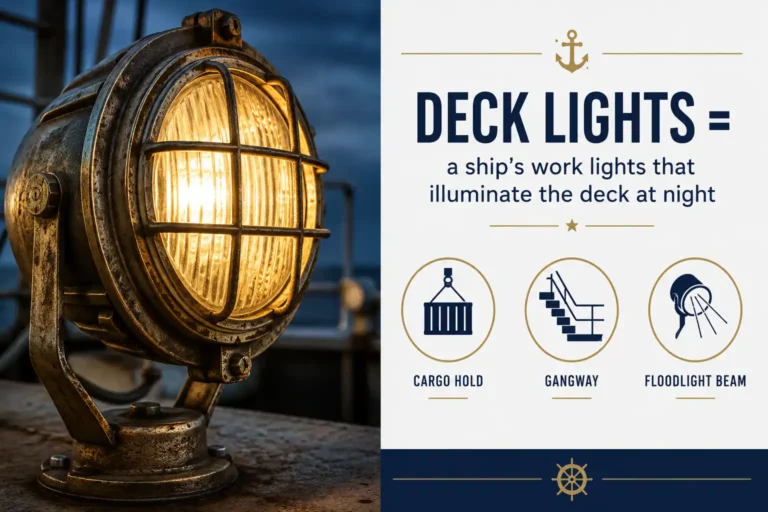
Beam angle comes first. Marine searchlights run 3 to 8 degrees. That is a tight column, not area lighting. A spread filter or flood adapter widens it, and without one you get a bright circle and black everywhere else. This is the opposite of what deck lighting is meant to cover on a working vessel.
Power draw comes second. A 2000W halogen pulls hard and gets hot enough to scorch paint at close range. Most of my display buyers fit an LED module inside the original drum. You keep the cast housing, the glass, and the bearing, and the draw falls to a fraction. Rewiring an old marine fixture for shore power is straightforward once the drum is stripped.
The housings themselves hold up well. These are IP56 stainless units built for green water breaking over the bow. That sealing standard, and how well marine housings shut out salt and rain, is why a forty year old drum still holds.
Final Thoughts
Brightness on a searchlight is one number, and it is candela. Watts and lumens will mislead you. Ask for peak beam intensity, take the square root, and you know what the beam will do before it ever leaves my yard.
If you are shopping the searchlights we pull out of the breaking yards, that one question sorts the honest listings from the guesswork. Enjoy the hunt.